

Key takeaways
- A cavity does not heal itself, so left alone it slowly grows deeper towards the sensitive inner tooth and the nerve.
- Untreated decay can progress from a painless hole to sensitivity, toothache, infection and abscess, and eventually tooth loss.
- Pain often comes late, so no pain is not proof a cavity is harmless; a dead nerve can even stop hurting while infection continues.
- A small cavity is usually one simple filling; the same cavity ignored can become a root canal and crown, or an extraction.
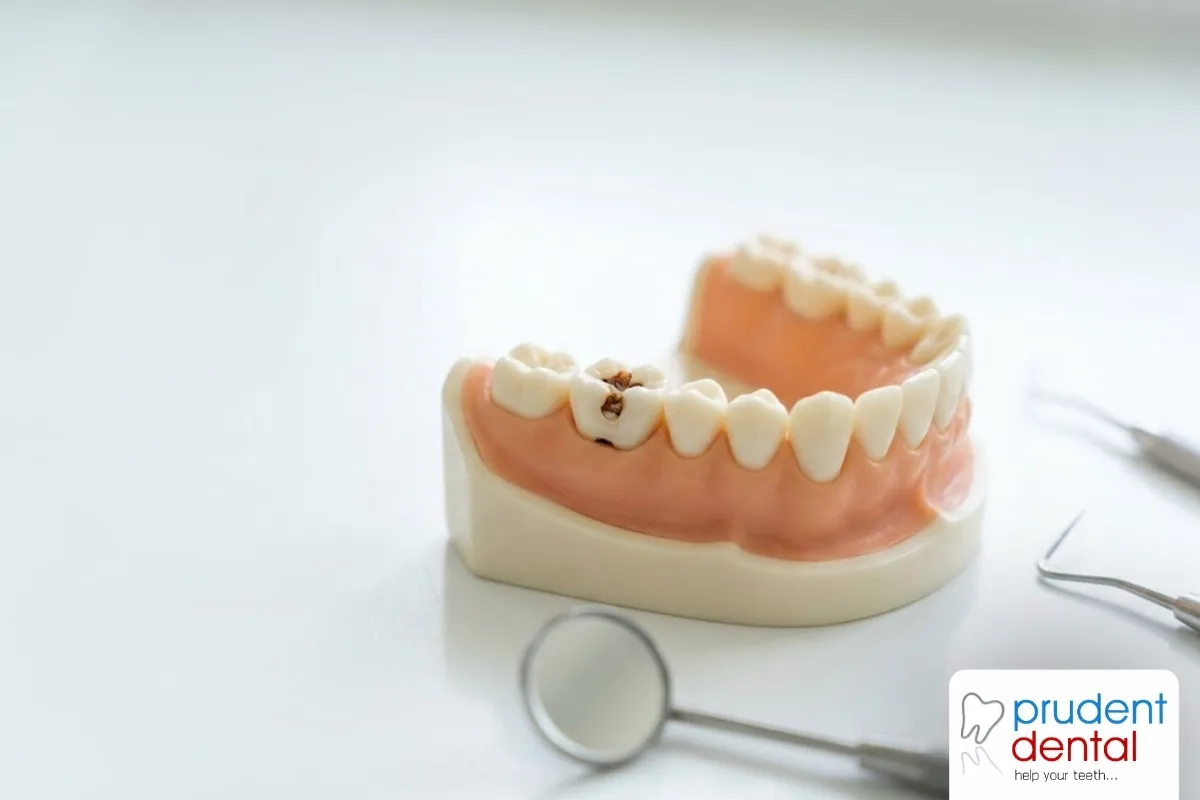
It is tempting to leave a small cavity alone, especially if it does not hurt. The problem is that a cavity is not a stable thing that stays put. It is active decay, and without treatment it tends to move in one direction only, slowly deeper. Understanding where that road leads makes the case for dealing with it early, while it is still simple.
How a cavity progresses if ignored
Decay starts in the hard outer enamel, which has no nerves, which is why an early cavity is usually painless. Left untreated, it works inward to the softer dentine beneath, and the tooth may start to feel sensitive to sweet, hot or cold. Deeper still, the decay reaches the pulp, the living centre of the tooth, and this is where a manageable problem becomes a painful one.
From hole to toothache to infection
Once bacteria reach the pulp, the tooth can develop a lingering toothache and the nerve can become infected. The infection can then travel to the tip of the root and form an abscess, causing swelling and significant pain, and in some cases spreading beyond the tooth. A dental abscess is not something to wait out. What could have been a quick filling has now become an urgent problem.
Why no pain is not reassurance
One of the traps with cavities is that pain arrives late. Early decay and even a fair-sized cavity often cause nothing at all, and a tooth whose nerve has died can actually stop hurting while the infection quietly continues. So the absence of pain tells you little about how far the decay has gone. This is the whole reason dentists check for decay at routine visits, to find it before it hurts.
The treatment ladder: simple now, or complex later
The practical consequence is a ladder of treatment. A small cavity is usually one straightforward filling. Let it reach the nerve and it may need a root canal and a crown. If the tooth is too far gone to save, the outcome is an extraction, and then the question of replacing the missing tooth. Every rung up that ladder means more time, more cost and more done to the tooth. Acting early keeps you on the bottom rung.
The sensible next step
If you suspect a cavity, or it has simply been a while since a check-up, the useful thing is to have it seen while it is small. A dentist can tell you how far the decay has gone and the simplest way to deal with it, which is almost always easier than what waiting would require. You can book an appointment to get it sorted early.
Sources & further reading
NIDCR, US National Institute of Dental & Craniofacial Research · American Dental Association (MouthHealthy) · NHS, Dental Health · Indian Dental Association
Leaving a cavity untreated: your questions answered
- Signs you have a cavity (and what happens next)
- Filling or root canal: which do I need?
- Dental abscess: when swelling becomes serious
- Composite fillings
- Jaw pain and TMD: causes, signs and what helps
- Cracked tooth: pain on biting, and what to do
- Loose tooth in adults: causes and what to do
- Wisdom tooth pain: what helps and when to remove
- Oral cancer: early signs you should never ignore
Got a cavity you have been putting off? It is simpler treated early. Call +91 70287 22200.
Call +91 70287 22200 · Open 7 days, 9 AM–9 PM (5 PM Sun)