

Key takeaways
- A sore, ulcer or patch that has not healed within two to three weeks should be examined, whatever it looks like.
- Early oral cancer is often painless, so a lack of pain is never a reason to wait.
- Tobacco in all forms, including gutkha, khaini and areca nut, along with heavy alcohol, are the major established risk factors, and prolonged sun exposure matters for lip cancer.
- Routine dental examinations include a soft tissue check of the whole mouth, and anything suspicious is referred promptly to a specialist for evaluation.
- Found early, oral cancer is usually simpler to treat, which is why regular check-ups and prompt attention to changes can genuinely save lives.
Most changes in the mouth are harmless, but a small number are early warning signs of oral cancer, and the difference cannot be judged by appearance or by whether something hurts. The signs worth knowing are a sore that does not heal within two to three weeks, a red or white patch, a lump or thickening, unexplained numbness, difficulty swallowing, and a denture that suddenly fits differently. Found early, oral cancer is usually far simpler to treat, which is why persistent changes should be examined rather than watched. This guide explains each sign calmly, names the established risk factors, and describes exactly what a routine dental examination does and does not do.
The warning signs to know
Oral cancer can develop anywhere in the mouth: on the tongue, the floor of the mouth, the inner cheeks, the gums, the lips or the palate. Early changes are frequently painless, which is exactly why they are so easy to dismiss. The most useful rule is based on time, not appearance. A sore, an ulcer or a patch that has not healed within two to three weeks is no longer routine, whatever it looks like, and it deserves a professional look.
None of these signs means you have cancer. Ulcers, patches and lumps have many everyday causes, from friction and accidental biting to infections, and the great majority turn out to be harmless. The point is not to alarm you but to remove the guesswork: appearance alone cannot tell you which changes are innocent, and neither can waiting. If a change has persisted, have it examined: that is the reliable way forward, whether the answer is reassurance in the chair or a prompt referral so a specialist can settle the question properly.
- A sore or ulcer that does not heal within two to three weeks
- A red patch, a white patch, or a mixed red and white patch on any surface of the mouth
- A lump, swelling or thickening in the mouth, on the lip or in the neck
- Unexplained numbness or tingling in the mouth, lip or tongue
- Difficulty or discomfort when chewing or swallowing, or a feeling of something caught in the throat
- A denture that suddenly fits differently or rubs where it never used to
- Persistent hoarseness, unexplained bleeding, or a tooth that loosens for no clear reason
Ordinary ulcer or something that needs checking
Almost everyone gets ordinary mouth ulcers from time to time, and they behave in a recognisable way: they are sore, they often have an obvious trigger such as a bite or a sharp tooth edge, and they usually heal on their own within two weeks. We cover the common types in our guide to mouth ulcers, their causes and treatment. A change that needs checking tends to behave differently, and the differences are worth knowing.
| Feature | Ordinary mouth ulcer | Change that needs checking |
|---|---|---|
| Pain | Usually sore, especially with spicy or acidic food | Often painless in the early stages |
| Healing | Usually heals on its own within two weeks | Persists beyond two to three weeks |
| Appearance | Round or oval with a defined border | May be a red patch, a white patch, a lump or a rough thickened area |
| Pattern | Comes and goes, often in familiar spots | Stays in one place and slowly changes |
| Other signs | None beyond soreness | Numbness, difficulty swallowing, a denture that stops fitting, a lump in the neck |
The established risk factors
Tobacco in every form is the most significant established risk factor for oral cancer. That includes smoked tobacco such as cigarettes and bidis, and the smokeless forms widely used in India: gutkha, khaini, mawa and paan with tobacco. Areca nut, or supari, carries risk on its own even without tobacco, and long term use is also linked to oral submucous fibrosis, a condition that stiffens the tissues of the mouth and is itself considered precancerous.
Heavy alcohol use is another established factor, and the combination of alcohol with tobacco raises risk further than either habit alone. Prolonged sun exposure matters specifically for cancer of the lip, which is relevant for anyone who spends long hours working outdoors. Some cancers of the mouth and throat are linked to HPV infection. It is also true that oral cancer can occur in people with none of these risk factors, so a persistent change deserves attention whoever you are.
The honest role of your dentist
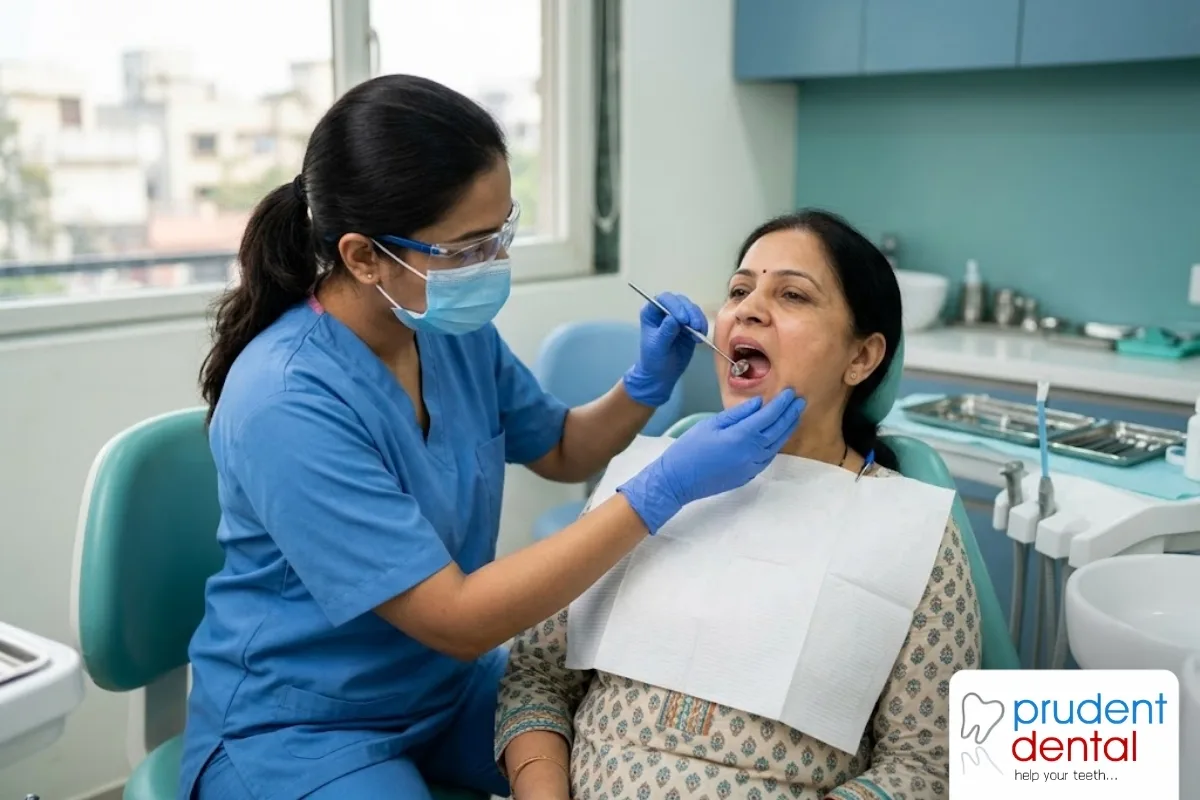
Every routine dental examination at Prudent Dental Clinic includes a check of the soft tissues, not just the teeth. That means looking at the lips, the inner cheeks, the sides and underside of the tongue, the floor of the mouth, the palate and the gums, and checking how dentures sit against the tissues beneath them. Dr. Puja Bansal, who has practised dentistry for 27 years and leads every case at the clinic, treats this soft tissue check as a fixed part of every examination, not an optional extra.
It is important to be honest about what a dental clinic can and cannot do. We do not diagnose oral cancer: diagnosis requires specialist assessment and testing. What a careful examination does is notice suspicious changes early, often before you have noticed them yourself, and refer you promptly to the right specialist for evaluation. That early referral is the entire value. When changes are found early, treatment is usually simpler and outcomes are usually far better.
When to book a check without waiting
Do not wait for your next scheduled visit if a sore has passed the two to three week mark, if you have noticed a patch, lump, numb area or a change in how your denture fits, or if swallowing has become difficult. You can book an appointment at the clinic any day of the week, and a persistent mouth change is always a valid reason to come in. Mention it when you book so it is examined first.
Between visits, a monthly self check takes only a few minutes in good light with a mirror: look at your lips inside and out, both cheeks, every side of your tongue, the floor of your mouth and the roof of your mouth, and feel gently along your neck for lumps. If you use tobacco or areca nut in any form, regular dental examinations matter even more, and quitting remains the single most effective step you can take. Your dentist can point you towards support for that too.
Oral cancer FAQs
Sources & further reading: NHS, Dental Health; American Dental Association (MouthHealthy); NIDCR, US National Institute of Dental & Craniofacial Research; Indian Dental Association.
Questions about your own teeth? Call +91 70287 22200.
Call +91 70287 22200 · Open 7 days, 9 AM–9 PM (5 PM Sun)