

Key takeaways
- Early cavities usually do not hurt. The first clues are sensitivity, a rough spot, a white or brown mark, or food that keeps trapping in one place.
- A cavity that has broken through the enamel cannot heal on its own and needs a filling.
- Only the very earliest white-spot stage can sometimes be reversed with fluoride and better cleaning.
- The longer decay is left, the bigger the treatment. A small filling today beats a root canal later.
Most people picture a cavity as an obvious, painful hole. In reality, tooth decay is quiet for a long time, and by the stage it hurts constantly it has often gone deep. The good news is that cavities give off earlier clues if you know what to look and feel for, and catching them early makes treatment far simpler.
This guide covers the real signs of a cavity, what causes decay in the first place, and what a dentist actually does about it, so you can act before a small problem becomes a big one.
The signs of a cavity, from subtle to obvious
Decay progresses through stages, and the signals change as it goes. Roughly in order of how early they appear:
- Sensitivity to sweet, hot or cold. Often the first hint, as decay thins the protective enamel.
- A rough or catchy spot. Your tongue snags on an area that used to feel smooth, or floss keeps shredding in one place.
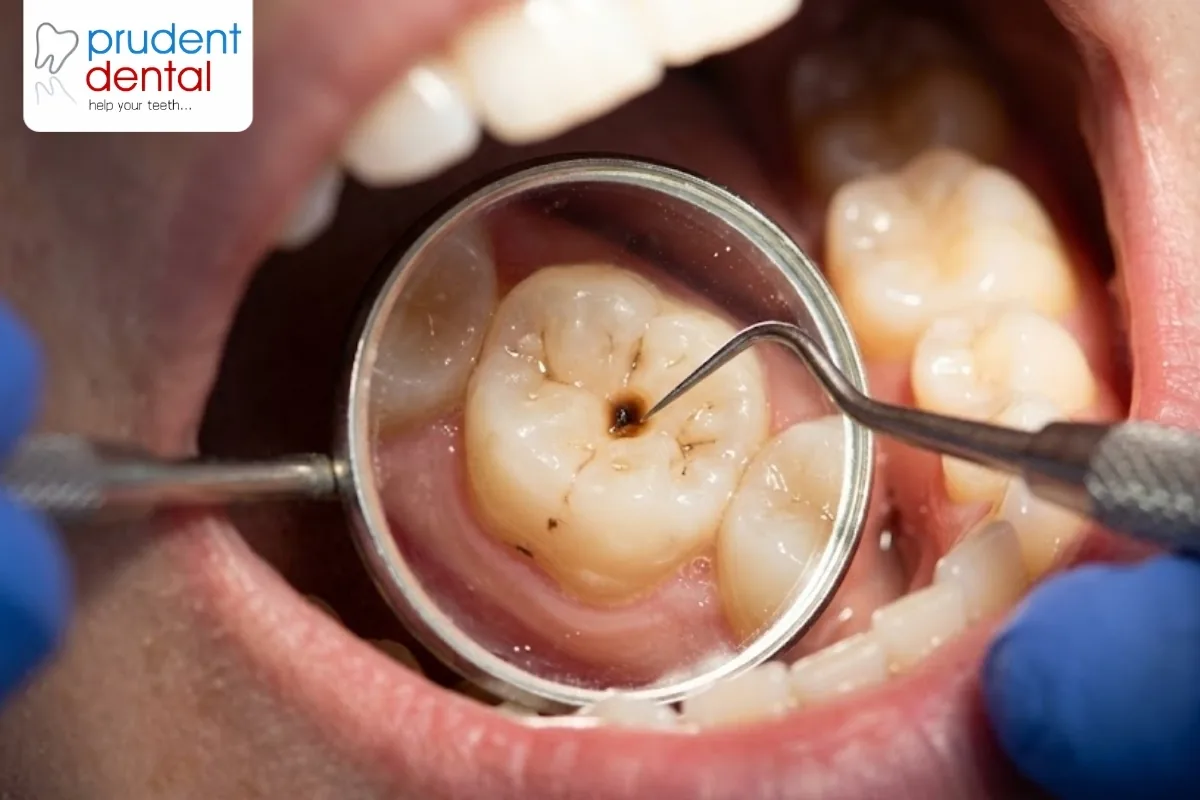
- A white, brown or black mark. A chalky white patch can be very early decay; brown or black staining in a pit or groove is often more advanced.
- Food trapping. Food that repeatedly packs into the same gap can signal a cavity forming between teeth.
- A visible hole or chip. By now the cavity is established and needs treatment.
- Ache or pain. Persistent or throbbing pain usually means the decay is deep, sometimes near the nerve.
Sensitivity has several causes, not just decay, and we cover the others in why are my teeth sensitive. The point is that any of these signs is worth a look, because a dentist can spot decay between teeth and under old fillings that you simply cannot see in a mirror.
| Sign | What you notice | What it usually means |
|---|---|---|
| Sensitivity to sweet, hot or cold | Brief twinges with certain foods or drinks | Often the first hint as enamel thins |
| Rough or catchy spot | Tongue snags, or floss shreds in one place | Early surface breakdown |
| White, brown or black mark | Chalky white patch or dark staining in a groove | White can be very early; dark is often more advanced |
| Food trapping | Food packs into the same gap repeatedly | Possible cavity forming between teeth |
| Visible hole or chip | A hole you can see or feel | Established cavity that needs treatment |
| Ache or pain | Persistent or throbbing pain | Deep decay, sometimes near the nerve |
Why cavities form
A cavity is the end result of a simple process. The bacteria in plaque feed on sugars and refined carbohydrates and produce acid. That acid strips minerals from the enamel, and if it happens faster than saliva can repair it, the surface eventually breaks down into a cavity. Frequent snacking, sugary and sticky foods, sipping sweet drinks through the day, poor cleaning and a dry mouth all tip the balance towards decay.
This is why where and how often you eat sugar matters as much as how much. Constant small exposures keep the acid attack going all day. Our guide to the best and worst foods for teeth goes into the practical swaps that help.
Can a cavity reverse itself?
Only at the very beginning. At the white-spot stage, the enamel has lost minerals but is still intact, and with fluoride, better plaque control and less frequent sugar it can sometimes re-harden before a hole forms. Once the surface has actually broken down, though, the damage is permanent and the tooth needs a filling. There is no toothpaste, supplement or home remedy that rebuilds a genuine cavity, whatever the internet claims.
What the dentist does, and why sooner is better
Treatment depends entirely on how far the decay has gone, which is the whole argument for catching it early:
- Small to moderate decay: the dentist removes the decayed part and places a tooth-coloured filling. Quick and straightforward.
- Larger decay: an inlay, onlay or crown may be needed to rebuild more of the tooth.
- Decay that reaches the nerve: the tooth may need a root canal before it can be restored.
- A tooth too damaged to save: occasionally extraction is the only option, which then leaves a gap to replace.
Every step down that list means more treatment, more time and more cost. A cavity found at a routine check-up is usually a five-minute filling; the same cavity ignored for a year can become a root canal. At Prudent Dental Clinic in Viman Nagar, Pune, an examination finds decay early, often before you feel a thing. The clinic is open seven days a week from 9 AM to 9 PM (5 PM on Sundays), and you can book online or call.
Sources & further reading
Indian Dental Association · World Health Organization, Oral Health · American Dental Association (MouthHealthy)
Cavity FAQs
Think you might have a cavity? Catch it early. Call +91 70287 22200 to book a check-up.
Call +91 70287 22200 · Open 7 days, 9 AM–9 PM (5 PM Sun)