Key takeaways
- Full mouth dental implants replace a whole arch with a fixed bridge anchored to four to six implants, not one implant per tooth.
- All-on-4 angles the rear implants to use available bone, which often avoids the need for a bone graft.
- The teeth are fixed and do not come out; unlike dentures, they also help slow the jawbone loss that follows tooth loss.
- Expect several months from surgery to the final bridge, though temporary fixed teeth can often be fitted much sooner.
- Candidacy depends on bone, gum health, smoking and controlled general health. It is decided from a scan, not a phone call.
Losing most or all of the teeth in a jaw is one of the harder things dentistry deals with, and the options are genuinely confusing. This guide explains what full mouth dental implants are in 2026, how All-on-4 and full-arch treatment actually work, who they suit, and how honestly they compare with dentures. It is written and medically reviewed by Dr. Puja Bansal, BDS, an implantologist with 27 years of experience at Prudent Dental Clinic in Viman Nagar, Pune.
What are full mouth dental implants?
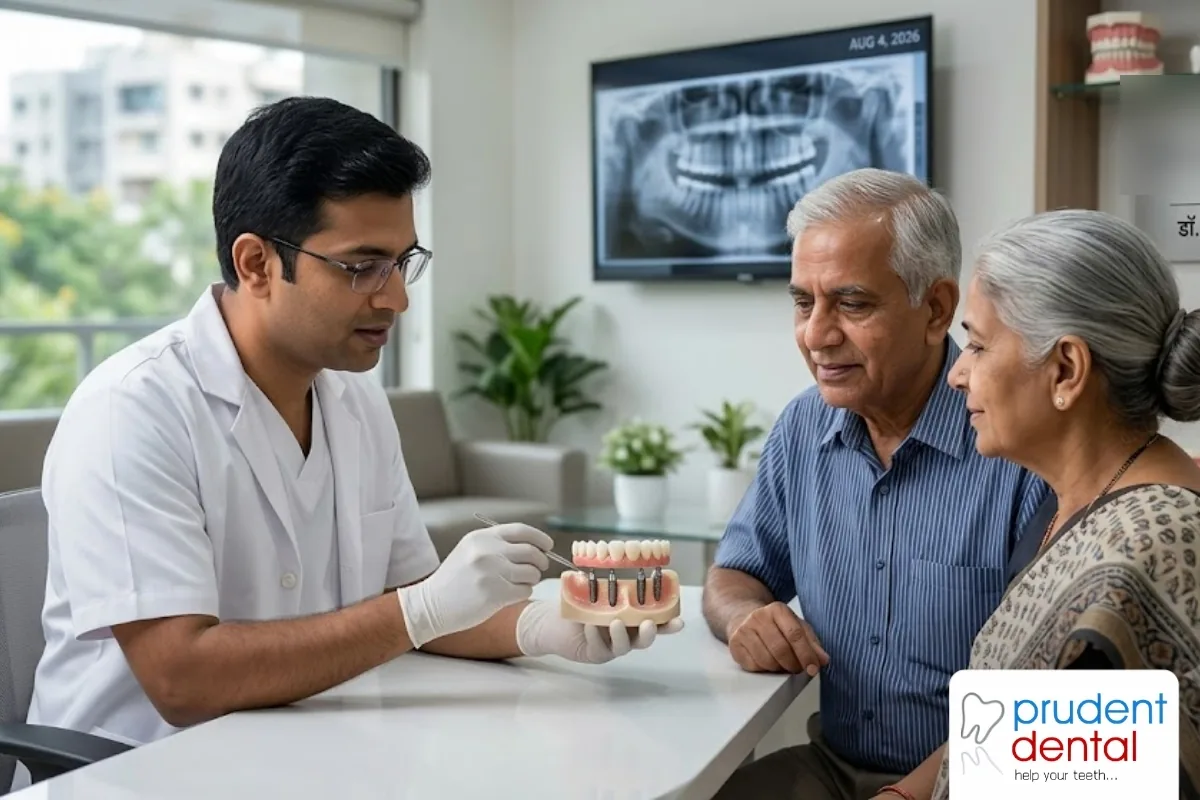
Full mouth dental implants replace an entire arch of teeth with a fixed bridge that is anchored to titanium implants set into the jawbone. The implants act as artificial tooth roots; the bridge is screwed onto them and stays in place permanently. You do not take it out at night, and it does not rest on the gums the way a denture does.
The important thing to understand is that you do not need one implant for every missing tooth. A full arch of twelve to fourteen teeth is normally carried by just four to six well-placed implants, because a rigid bridge spreads the biting load across them. This is what makes full-arch treatment practical rather than impossibly invasive. You can read more on the full mouth dental implants page.
What is All-on-4, and how is it different?
All-on-4 is a specific full-arch technique in which four implants support one fixed bridge. Its defining feature is that the two rear implants are placed at an angle rather than straight down. Tilting them lets the surgeon anchor into the denser bone at the front of the jaw and avoid the areas where bone is usually thinnest, most commonly above the back of the upper jaw near the sinus.
That angling matters for a practical reason: it often means treatment is possible without a bone graft, which removes months of extra healing and a second surgical stage. All-on-6 follows the same principle with six implants, giving more support where bone allows or where bite forces are heavy. Neither is automatically better; the right number comes from your scan.
Full mouth implants vs dentures: an honest comparison
This is the comparison most patients are actually weighing. Both replace a full arch, but they behave very differently day to day, and dentures are not simply the inferior option, they are the more accessible one.
| Factor | Full-arch implants | Conventional dentures |
|---|---|---|
| Stability | Fixed; do not move when eating or speaking | Rest on the gums; can move, may need adhesive |
| Jawbone | Implants load the bone, helping slow bone loss | Bone continues to shrink underneath over time |
| Chewing | Closer to natural bite force; wider diet | Reduced bite force; some foods stay difficult |
| Surgery | Yes, and healing time is required | None |
| Cost | Higher upfront investment | Markedly lower upfront |
| Best when | Bone and health allow; you want fixed teeth | Surgery, bone volume, health or budget rule implants out |
If you are still deciding between all the ways to replace teeth, our guide to missing-tooth replacement options covers bridges and partial solutions too, and the dentures and prosthesis page explains the removable route in detail.
Who is a candidate for full mouth implants?
Candidacy for full mouth dental implants is decided from an examination and a 3D scan, because the deciding factors are inside the jaw. The surgeon is looking for enough bone volume and density to hold implants securely, healthy gum tissue, no active untreated infection, and general health stable enough for a surgical procedure.
Several things make treatment more complicated rather than impossible. Smoking measurably raises the risk of implant failure. Uncontrolled diabetes slows healing. Heavy grinding puts extra load on the bridge. Thin bone may need grafting first, or may steer the plan towards angled implants. Our posts on implant candidacy and implants with diabetes and smoking go deeper on each of these.
What does the treatment timeline look like?
Full mouth implant treatment is a staged process spread over months, not a single appointment. A typical sequence looks like this:
- Consultation, examination and a 3D scan to assess bone and plan implant positions
- Any preparatory work: treating gum disease, removing unrestorable teeth, grafting if needed
- Surgical placement of the implants, usually under local anaesthetic with sedation
- A temporary fixed bridge in suitable cases, so you are not without teeth
- Healing while the implants fuse with bone, commonly around three to six months
- Fitting of the final bridge, then a review schedule and ongoing maintenance
The healing stage is the part that cannot be rushed. Implants work because bone grows tightly onto their surface, and that biology takes the time it takes. A clinic promising a permanent full-mouth result in days is describing a temporary bridge, and you should ask them to say so plainly.
What are the risks and what does maintenance involve?
Full-arch implant treatment is well established and, in properly selected patients, has a strong track record. It is still surgery, and the honest risks include infection, implant failure to integrate, nerve or sinus complications, and later problems such as peri-implantitis, an inflammatory condition around implants that behaves like gum disease and can cost you bone if ignored.
Maintenance is not optional. Fixed full-arch teeth need daily cleaning underneath the bridge with the tools your dentist provides, plus professional reviews so early problems are caught while they are still small. The prosthesis itself is a wearing part and may need servicing or replacement over the years even when the implants remain sound. Anyone presenting this as fit-and-forget dentistry is overselling it.
Getting an assessment in Pune
Because everything here turns on your bone, gums and general health, the only useful next step is an examination with imaging. At Prudent Dental Clinic in Viman Nagar, Pune, Dr. Puja Bansal, BDS assesses whether full-arch treatment is realistic for you, what preparatory work would be needed, and what the alternatives are, and you get a written itemised estimate before anything is committed to. The clinic is open seven days, 9 AM to 9 PM, and 9 AM to 5 PM on Sundays. You can book an assessment or call +91 70287 22200.
Sources & further reading
American Dental Association (MouthHealthy) · NIDCR, US National Institute of Dental & Craniofacial Research · FDI World Dental Federation · Indian Dental Association
Full mouth dental implants: your questions answered
Considering full mouth implants? Start with an assessment. Call +91 70287 22200.
Call +91 70287 22200 · Open 7 days, 9 AM–9 PM (5 PM Sun)