

Key takeaways
- A gap left after tooth loss rarely stays the same: neighbouring teeth drift into it, the opposing tooth can over-erupt, and the jaw bone beneath slowly shrinks.
- Implants, bridges and dentures can all restore chewing. They differ mainly in what they ask of the neighbouring teeth and what happens to the bone.
- Only an implant replaces the root of the tooth, which is why it is the one option that helps preserve the jaw bone in the gap.
- Replacing a tooth earlier is usually simpler; long-standing gaps may need bone grafting or orthodontic treatment before replacement becomes possible.
Losing a tooth (to deep decay, gum disease, an accident or a planned extraction) leaves more than a cosmetic gap. The mouth is a balanced, moving system. When one part goes missing, the rest slowly rearranges itself around the space. This guide looks at what actually happens if a gap is left alone, compares the three main replacement options, and explains why the decision tends to get harder the longer it waits.
What happens if I don't replace a missing tooth?
Over time, the neighbouring teeth tend to drift and tilt into the gap, the opposing tooth can over-erupt, and the jaw bone under the space slowly shrinks. The result can be food trapping, gum problems, an uneven bite and a harder, costlier replacement later. A gap rarely stays just a gap.
Teeth hold their positions partly because they lean on each other. Remove one, and that balance is gone. The teeth on either side of the space begin to drift and tilt into it, slowly and painlessly, over months and years. Meanwhile the tooth in the opposite jaw, which used to bite against the missing one, may over-erupt. It gradually moves out of its socket in search of contact. Tilted and over-erupted teeth create tight, awkward corners that trap food and are difficult to clean, which raises the risk of decay and gum inflammation around teeth that were perfectly healthy before.
These shifts can also unsettle the bite itself. Chewing naturally moves to the more comfortable side, overloading those teeth, and a changed bite can strain the jaw muscles and joint. Dentists sometimes describe the end stage of this slow domino effect as bite collapse, and it can begin with a single unreplaced gap.
The least visible change happens in the bone. Jaw bone stays dense because tooth roots transmit chewing forces into it. When a root is lost, that stimulation stops and the bone in the area gradually shrinks, a process called resorption. This is the change that matters most for the future: the less bone remains, the more involved an implant becomes, sometimes requiring a grafting procedure first.
What is the best way to replace a missing tooth?
There is no single best option for everyone. A dental implant is the closest replacement to a natural tooth and helps preserve bone; a fixed bridge is quicker but involves the neighbouring teeth; a removable denture is the most economical, especially when several teeth are missing. The right choice depends on your mouth, health and priorities.
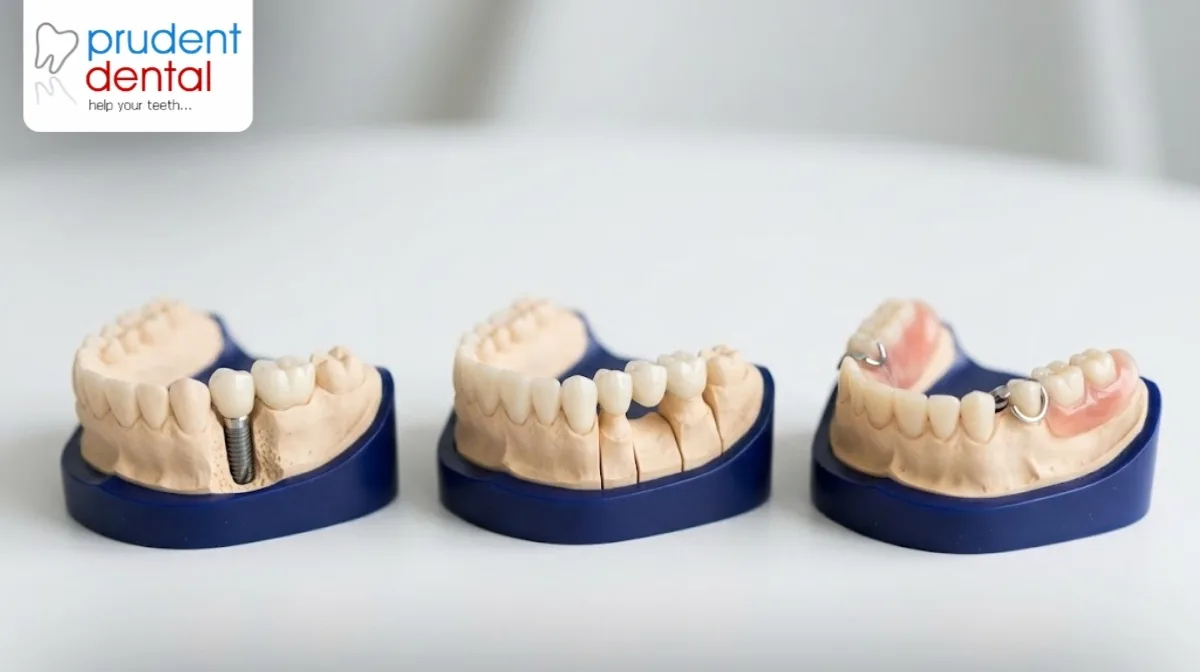
The three families of options are a dental implant, a fixed bridge and a removable denture. Here is how they compare on the points that matter most in the long run:
| Dental implant | Fixed bridge | Removable denture | |
|---|---|---|---|
| What it is | A titanium post in the jaw topped with a crown, replacing both root and crown | A false tooth fixed to crowns on the teeth either side of the gap | A removable plate carrying one or more false teeth |
| Treatment journey | Minor surgery, a healing period of some months, then the crown | No surgery; usually completed across a small number of visits | Impressions and fitting over a few visits; no surgery |
| Neighbouring teeth | Left completely untouched | Permanently reshaped to carry the bridge | Untouched, though clasps may rest on them |
| Jaw bone in the gap | Stimulated by chewing forces, which helps limit shrinkage | Continues to shrink slowly beneath the false tooth | Continues to shrink; the denture may need relining over time |
| Often chosen when | A single gap has healthy neighbours and adequate bone | The adjacent teeth already need crowns, or surgery is unsuitable | Several teeth are missing, or a fixed budget takes priority |
No single option wins every time. A well-planned bridge remains a time-tested solution, and modern dentures and prostheses can restore function convincingly when several teeth are missing. What changes is how the three options behave in the mouth over the years, especially where the neighbouring teeth and the bone are concerned.
Implant or bridge, which is better?
For a single missing tooth with healthy neighbours, an implant is often preferred because it works independently and helps maintain the bone. A bridge can be the better choice when the adjacent teeth already need crowns, when treatment time matters, or when surgery is not advisable. A dentist can only say after an examination and X-ray.
The practical difference comes down to what each option asks of the rest of your mouth. A bridge is carried by the teeth on either side of the gap, which must be reshaped to receive crowns. If those teeth are already heavily filled or crowned, little is lost, and the bridge effectively restores three teeth at once. If they are healthy and untouched, permanently reshaping them is a genuine trade-off worth discussing openly with your dentist.
An implant asks nothing of the neighbouring teeth, but it does require minor surgery, adequate bone, healthy gums and a healing period of some months before the final crown is fitted. In return, it is the only option that replaces the root and helps preserve the bone in the gap. For a closer look at longevity, candidacy and care, see our guide on whether dental implants are worth it.
Why is it easier to replace a tooth sooner?
Because the changes described above (drifting, over-eruption and bone shrinkage) are progressive. Replace a tooth while the space is intact and the bone volume is good, and treatment is usually straightforward. Wait years, and the same replacement may first require bone grafting, or orthodontic work to reopen a collapsed space.
None of this means panic-booking the week after an extraction: the gum and bone need time to heal, and your dentist will advise the right window for your situation. It simply means a gap deserves a plan rather than a shrug. At Prudent Dental Clinic in Viman Nagar, Pune, replacement planning starts with an examination and X-ray by Dr. Puja Bansal (BDS), an implantologist with 27 years of experience; the clinic has treated patients since 2005 and is open seven days a week, 9 AM to 9 PM (5 PM on Sundays). If you are weighing a gap right now, you can book a consultation and compare your options with someone who can actually see them.
Replacing many teeth, or hoping for teeth in one visit? See our 2026 guides to full mouth implants and same-day dental implants.
Sources & further reading
Indian Dental Association · World Health Organization, Oral Health
Missing tooth questions, answered
Missing a tooth? Discuss your options with Dr. Bansal. Call +91 70287 22200.
Call +91 70287 22200 · Open 7 days, 9 AM–9 PM (5 PM Sun)