Key takeaways
- Good candidates usually have healthy gums, enough jaw bone, stable general health, and are non-smokers or willing to stop around surgery.
- Enough bone is judged from an X-ray or CBCT scan, not from how the gap looks. No dentist can decide candidacy by eye alone.
- Being told "not yet" is common and rarely final. Treating gum disease or adding a bone graft often turns a no into a yes.
- A consultation and scan decide. This article helps you prepare for that conversation; it cannot replace it.
Dental implants suit a lot of people, but not everyone, and not always straight away. If you are wondering whether you qualify, the honest answer is that a short checklist can tell you a great deal, while a proper examination and scan settle it. Here is what dentists actually look for.
Am I a good candidate for dental implants?
You are likely a good candidate if your gums are healthy, you have enough jaw bone to hold an implant, your general health is stable, and you either do not smoke or are willing to stop around the surgery. Realistic expectations matter too. A consultation and scan confirm it.
None of those boxes is exotic. Most healthy adults who look after their teeth tick them without trouble. What the checklist really guards against is placing an implant into a mouth that is not ready to heal around it. An implant relies on living bone growing tightly against its surface, so the whole assessment is about giving that process the best possible start.
It also helps to know why one tooth was lost in the first place. If decay or an accident was the cause, the outlook is usually straightforward. If gum disease was to blame, that underlying problem has to be settled before a new implant is exposed to the same conditions.
Who cannot get dental implants right away?
Implants are usually delayed, not refused, for people with untreated gum disease, poorly controlled diabetes, heavy smoking habits, or too little bone at the site. Teenagers whose jaws are still growing are asked to wait. Most of these are temporary obstacles that can be managed first.
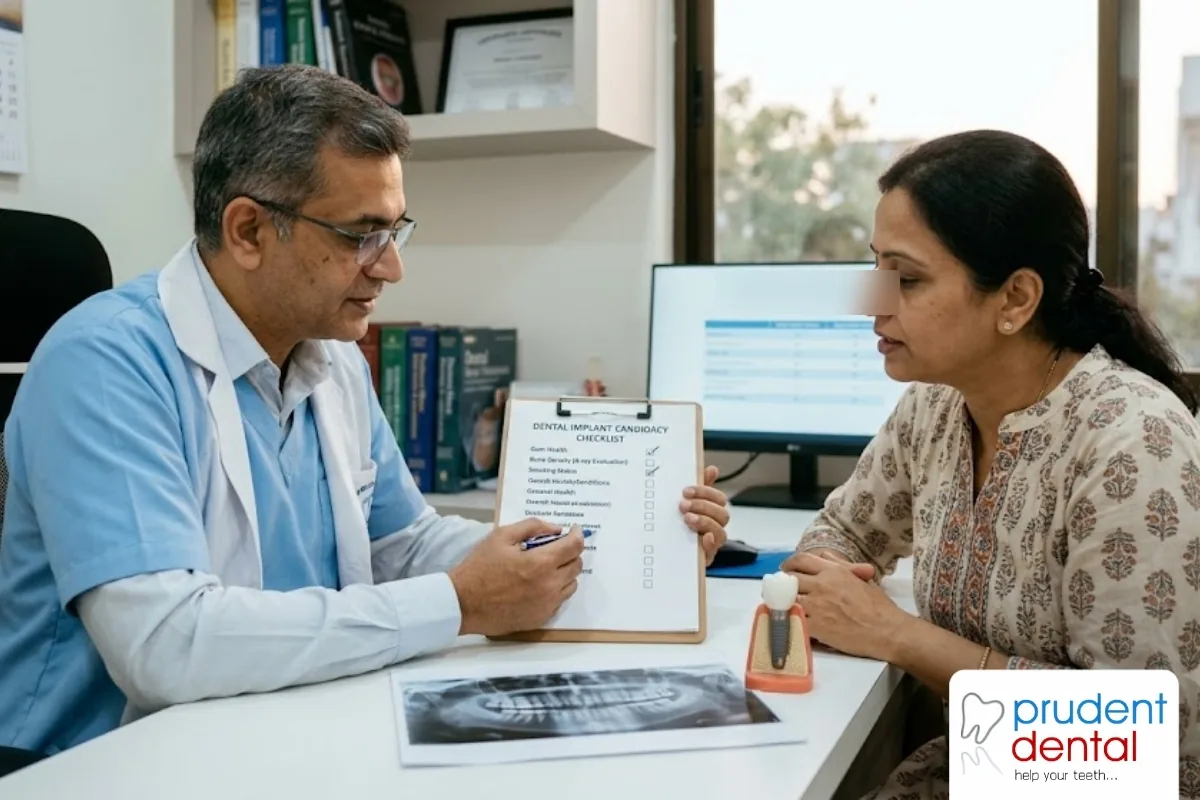
Think of the checklist as five things a dentist weighs together. No single item is a simple pass or fail; they are read alongside your scan and medical history.
| What is assessed | Why it matters | If it is a problem |
|---|---|---|
| Gum health | Implants need healthy, infection-free gums to heal and last. | Gum disease is treated and stabilised before planning begins. |
| Jaw bone volume | Enough bone must be present to anchor the implant securely. | A bone graft can often rebuild volume, adding time to treatment. |
| General health | Well-controlled health supports the healing an implant depends on. | Conditions like diabetes are stabilised, not necessarily a barrier. |
| Smoking | Smoking slows healing and is a strong risk factor for problems. | Quitting, or pausing around surgery, improves the outlook. |
| Expectations | Implants need daily care and a healing period, not a quick fix. | A frank consultation sets realistic timelines and aftercare. |
Notice how the third column almost always points to a next step rather than a closed door. That is the honest picture: being told "not yet" is common, and it usually comes with a plan to get you ready. You can read more about how diabetes and smoking affect implant healing if either applies to you.
What disqualifies you from dental implants?
Very little rules implants out permanently. Ongoing infection, bone loss that cannot be rebuilt, or a serious uncontrolled medical condition can make treatment unwise for now. Even then, a dentist can suggest alternatives. A consultation and scan decide what is safe for you.
The one thing that cannot be judged by eye is bone. From the outside a gap may look perfectly healthy while the bone beneath has quietly shrunk after months or years without a tooth. This is exactly why imaging is not optional. A digital X-ray or CBCT scan shows the height, width and quality of the bone, and reveals nearby nerves and the sinus, so an implant can be planned around them safely.
If the scan shows too little bone, that is often the beginning of a plan rather than the end of one. Grafting can rebuild the site, and after a healing period the implant can be placed. Where an implant genuinely is not the right route, a well-made bridge or denture may serve you better, and an honest dentist will say so.
What to do if you are told you are not ready
Hearing "not yet" is far more common than a flat no, and it is rarely bad news. It simply means one part of the picture needs attention first. Here is the usual sequence.
- Treat active gum disease. Professional cleaning and, where needed, deeper treatment settle inflammation so the mouth can heal.
- Stabilise your general health. Getting conditions such as diabetes well controlled improves how the site heals around an implant.
- Cut down or stop smoking. Even a pause around surgery meaningfully improves the odds of a good outcome.
- Rebuild bone if the scan calls for it. A graft restores volume; after it heals, the implant can usually go ahead.
- Re-assess with a fresh scan. Once the groundwork is done, imaging confirms whether the site is now ready.
This is why candidacy is decided by assessment rather than assumption. At Prudent Dental Clinic in Viman Nagar, Pune, implant planning is led by Dr. Puja Bansal (BDS), an implantologist with 27 years of experience (Maharashtra State Dental Council reg. A8860). An examination and implant consultation come first, and a scan settles the bone question, before anyone tells you whether an implant is right for your mouth. If you would like that assessment, you can book a consultation. The clinic is open seven days a week, 9 AM to 9 PM (5 PM on Sundays), on +91 70287 22200.
If you are looking at a bigger case, our 2026 guides to full mouth dental implants and same-day implants cover full-arch and immediate-load treatment in depth.
Sources & further reading
Indian Dental Association · NHS, Dental Health
Implant candidacy questions, answered
Wondering if implants suit you? Ask Dr. Bansal. Call +91 70287 22200.
Call +91 70287 22200 · Open 7 days, 9 AM–9 PM (5 PM Sun)