Key takeaways
- Diabetes by itself rarely rules out implants. What matters is how well blood sugar is controlled, because that supports healing.
- When diabetes is well managed, healing may simply be slower and needs closer monitoring rather than being ruled out.
- Smoking meaningfully raises the risk of implant problems and slower healing. Stopping, even temporarily around surgery, is thought to help.
- Neither condition is decided by a blanket rule. Your dentist and physician assess you individually before any implant is planned.
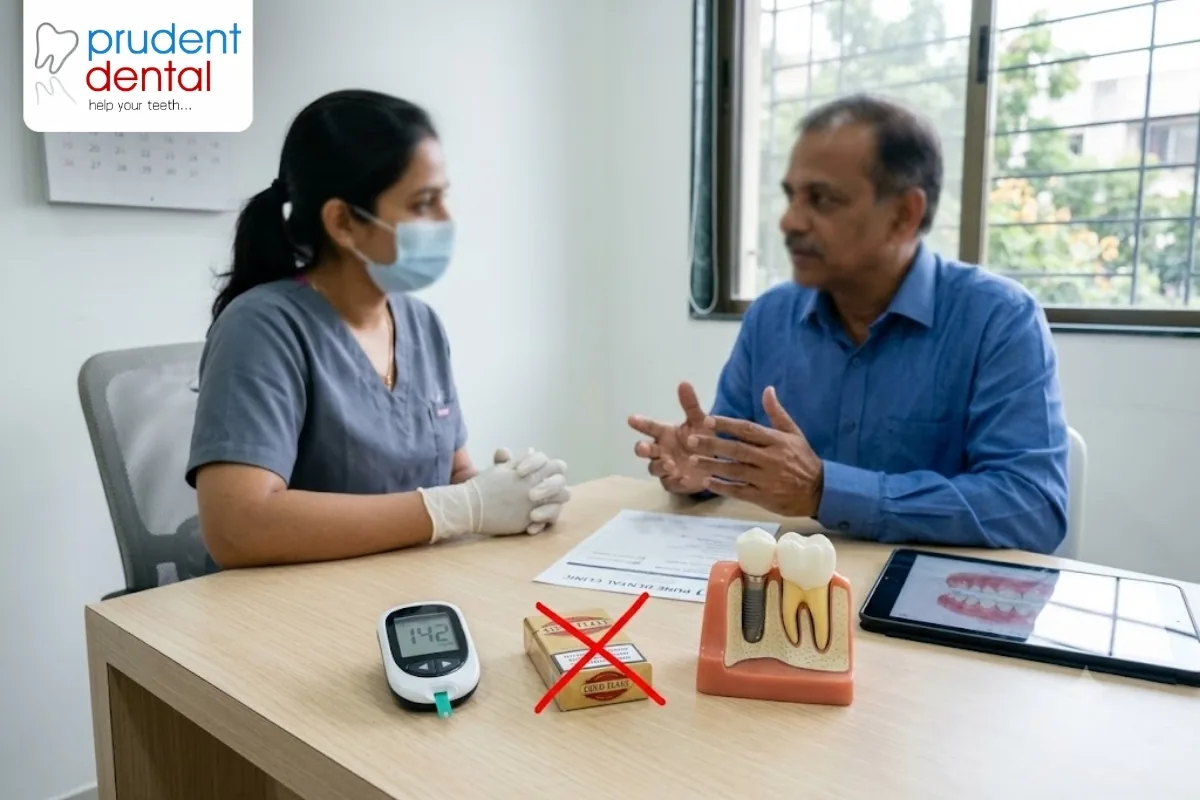
If you live with diabetes, or you smoke, you may have been told an implant is off the table. That is often not the case. Both conditions do affect how the mouth heals, so they change how carefully a case is planned and monitored, not always whether it can go ahead. Here is a calm, honest look at what each means.
Can diabetics get dental implants?
In many cases, yes. Diabetes on its own is not usually a barrier to a dental implant. What matters far more is how well your blood sugar is controlled. When diabetes is well managed, healing may simply be slower and needs closer monitoring, rather than the implant being ruled out.
The reason comes down to healing. An implant succeeds when the surrounding bone grows against it and holds it firmly, a process that unfolds over the weeks after surgery. Consistently high blood sugar can impair that healing and make infection more likely, which is why control matters more than the diagnosis itself. Someone whose diabetes is steady and well managed is in a very different position from someone whose levels swing widely.
Diabetes and gum health are also closely connected, and gum health underpins any implant. Our companion guide on the two-way link between diabetes and gum disease explains why keeping the gums healthy is part of the same picture. In practice, a dentist planning an implant will often want to understand your recent control and may ask you to coordinate with the doctor who manages your diabetes before going ahead.
Can smokers get dental implants?
Smokers can still be considered for implants, but smoking meaningfully raises the risk of problems and slower healing, so it is taken seriously in planning. Many dentists encourage stopping, or at least pausing around the time of surgery, because that appears to help. The decision always follows an individual assessment.
Smoking works against implants in more than one way. It reduces blood flow to the gums, which slows the healing the implant relies on, and it makes infection around the implant more likely in the months and years that follow. This is why smoking is repeatedly named among the stronger risk factors for implant problems. None of this means an implant is impossible if you smoke. It means the conversation about risk, and about cutting back, is an honest and necessary one.
The encouraging part is that some of this risk is within your control. Stopping smoking, even temporarily around the surgery and the early healing weeks, is widely thought to improve your odds. Your dentist can advise a realistic timeframe for your case and point you toward support if you want to stop for good.
Does smoking cause implant failure?
Smoking is consistently linked with poorer implant outcomes and is one of the stronger risk factors for problems, but it does not guarantee failure. It slows healing and raises the chance of infection around the implant. Stopping, even temporarily around surgery, is thought to improve your chances of a lasting result.
It helps to see how these two factors sit alongside the ordinary steps that protect any implant. The table below is a general guide, not a verdict on any individual case. Only a proper assessment can tell you where you personally stand.
| Factor | Why it matters for an implant | What can help |
|---|---|---|
| Blood sugar control | Steady control supports the bone healing an implant depends on; poor control can slow it and raise infection risk | Work with your physician to keep diabetes well managed before and after surgery |
| Smoking | Reduces blood flow to the gums, slows healing and raises the chance of infection around the implant | Stopping, or at least pausing around surgery and early healing, is thought to help |
| Gum health | Healthy gums are the foundation for any implant; active gum disease is treated first | Professional cleaning and stabilising the gums before implant planning |
| Daily hygiene and reviews | Plaque around an implant can inflame the gum and bone that hold it in place | Careful daily cleaning and keeping regular professional check-ups |
Smoking and diabetes are far from the only reasons an implant can struggle. For the fuller picture, our guide to what causes dental implants to fail covers infection, planning and hygiene as well. The recurring theme across all of them is that most problems are reduced, though never fully removed, by good assessment and good aftercare.
How your dentist decides
Because both diabetes and smoking affect healing rather than automatically ruling implants out, candidacy is settled by assessment, not by a label. At Prudent Dental Clinic in Viman Nagar, Pune, implant planning is led by Dr. Puja Bansal (BDS), an implantologist with 27 years of experience. An examination, an X-ray and a proper review of your medical history and any medication come first.
From there, the approach is individual. For someone with diabetes, that may mean confirming your control is steady, sometimes in coordination with the physician who looks after you, and monitoring healing more closely afterwards. For someone who smokes, it means an honest discussion about the added risk and about pausing around surgery. No outcome can ever be guaranteed, but a clear-eyed plan gives an implant its best chance. If you would like to talk it through, you can book a consultation or call +91 70287 22200. The clinic is open seven days a week, 9 AM to 9 PM (5 PM on Sundays).
Replacing many teeth, or hoping for teeth in one visit? See our 2026 guides to full mouth implants and same-day dental implants.
Sources & further reading
World Health Organization, Oral Health · NHS, Dental Health
Implants with diabetes or smoking, answered
Diabetes or a smoking habit? Talk it through with Dr. Bansal. Call +91 70287 22200.
Call +91 70287 22200 · Open 7 days, 9 AM–9 PM (5 PM Sun)