

Key takeaways
- Every root canal starts with an examination and X-ray; treatment is never planned blind.
- The tooth is fully numbed first, so cleaning the canals feels like pressure and vibration, not pain.
- An antibacterial dressing between sittings is routine when infection needs time to settle.
- Molars, retreatments and active infection are the usual reasons a tooth needs two or three visits.
- A crown fitted soon after the final sitting protects the treated tooth from cracking.
A root canal removes the infected or inflamed pulp from inside a tooth, cleans and shapes the hollow canals in its roots, then fills and seals them so the tooth can be kept rather than extracted. Depending on the tooth and the state of the infection, treatment finishes in one sitting or is spread over two or three. Each visit has a clear purpose, and none of them should hurt once the tooth is numb. This guide walks through exactly what happens at every stage, and why your dentist may plan more than one appointment.
Visit one: examination, X-ray and the plan
Treatment never starts blind. The dentist first confirms the tooth actually needs root canal treatment, because a deep filling or a cracked cusp can mimic pulp pain. You can expect gentle tapping to check tenderness, a cold test to see how the nerve responds, and a small X-ray to look for decay reaching the pulp or a dark shadow of infection around the root tip. Once the diagnosis is clear, you get a plan: which tooth, how many likely sittings, and a written itemised estimate before any drilling begins.
If you arrive in severe pain, the first visit usually doubles as relief. Numbing the tooth and opening it to release the pressure inside usually eases the worst of the pain quickly, even before the canals are properly cleaned. The clinic is open seven days a week, including Sundays, so a painful tooth does not have to wait for a convenient date.
Numbing, opening the tooth and cleaning the canals
The tooth is numbed with local anaesthetic and the dentist waits until it is fully asleep before touching it; if you can still feel anything, more anaesthetic is given. A thin rubber sheet is often placed around the tooth to keep it dry and protect the rest of your mouth. Modern root canal treatment feels far closer to having a filling than to the ordeal people imagine, and we have written separately about whether a root canal hurts if pain is your main worry.
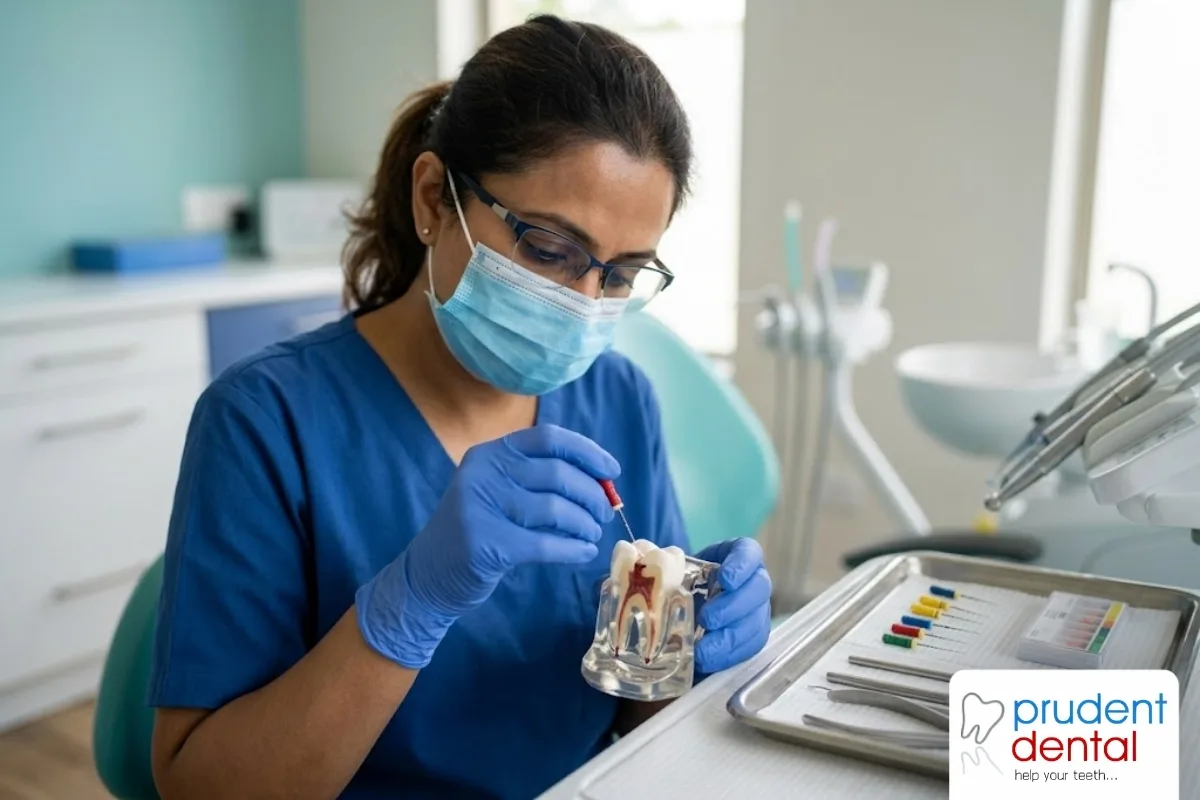
A small opening is made through the biting surface to reach the pulp chamber. The dentist then locates each canal and cleans it with fine flexible files, removing the inflamed or infected tissue and shaping the canal so it can be filled properly. Antiseptic solution is washed through repeatedly to flush out debris and bacteria. You will feel vibration and pressure, but the tooth should not hurt once it is numb. The length of this stage depends mostly on how many canals the tooth has, since front teeth usually have one and molars often have three or four.
Between sittings: medication when infection needs settling
When the pulp has died and infection has spread beyond the root tip, filling the canals immediately can trap bacteria inside. In these cases the dentist places an antibacterial dressing, commonly a calcium hydroxide paste, inside the cleaned canals and seals the tooth with a temporary filling. The dressing works quietly between appointments, usually spaced about a week or two apart, giving the infection time to settle before the permanent filling goes in. This is routine, not a sign that something has gone wrong.
Mild tenderness for a day or two after each sitting is common and usually settles with the painkillers your dentist suggests. Avoid chewing hard food on the temporary filling, and keep the area clean as normal. Call the clinic promptly if you develop facial swelling, fever, a bad taste that will not clear, or pain that is getting worse rather than better; these can mean the infection needs attention before your next scheduled visit. The clinic is open seven days a week on +91 70287 22200.
Filling, sealing and the crown
Once the canals are clean, dry and free of symptoms, they are filled with gutta-percha, a rubber-like material that is compacted into each canal with a sealing cement to close the space against bacteria. The access opening is then closed with a permanent filling that rebuilds the core of the tooth. At this point the root canal itself is finished, but the tooth is not yet fully protected, and that last step matters more than many patients realise.
A root-treated tooth no longer has a living pulp and tends to become more brittle over time, and back teeth take heavy chewing forces. A crown caps the whole tooth and greatly reduces the risk of it cracking, which is why dentists usually recommend one for treated molars and premolars. It is best fitted soon after the final sitting rather than left for months. We explain the options, materials and timing in our guide to the crown after a root canal.
Why some teeth finish in one sitting and others need three
There is no single correct number of visits, and a dentist who plans two sittings is not doing a lesser job than one who finishes in one. Single-visit treatment suits teeth where the pulp is inflamed but not heavily infected, so the canals can be cleaned, dried and filled in the same appointment. Multiple visits are the safer choice when there is active infection, pus draining through the tooth, or anatomy that simply needs more time to manage properly.
Straightforward cases at Prudent Dental Clinic are treated by Dr. Puja Bansal, who leads every treatment plan. Complex ones, such as retreatments, sharply curved or blocked canals, and teeth with unusual anatomy, are handled by consultant endodontist Dr. Mrunal Godse, who holds an MDS in Conservative Dentistry and Endodontics and has spent eighteen years in precisely this work. Being told your tooth needs a specialist or an extra sitting is honest planning, not upselling; the aim is a well-sealed tooth you can keep.
- Active infection or an abscess: the canals need medication time before they can be safely sealed
- Number and shape of canals: molars have more canals, often curved or narrow, and take longer to clean thoroughly
- Retreatment: removing an old root filling before cleaning again almost always needs an extra sitting
- Calcified canals: canals narrowed by age or an old injury are slower to locate and negotiate
- How the tooth settles: if tenderness persists at the next visit, sealing is postponed until the tooth is comfortable
Every stage at a glance
The table below sums up the journey from first X-ray to final crown. Timings vary from tooth to tooth, so treat it as a map rather than a timetable; your dentist will confirm the likely number of sittings after the examination, along with a written itemised estimate covering everything from the root canal itself to the crown. What the treatment costs depends on factors such as which tooth is involved, how many canals it has, whether it is a first treatment or a retreatment, and the type of crown chosen.
| Stage | What happens | How it feels |
|---|---|---|
| Examination and X-ray | The tooth is tested and X-rayed to confirm the diagnosis | Usually comfortable; a tender tooth may twinge briefly during tapping tests |
| Numbing | Local anaesthetic is placed around the tooth | A small pinch, then the area goes numb |
| Opening and cleaning | The pulp is removed and the canals are cleaned and shaped | Vibration and pressure, not pain |
| Medication, if needed | An antibacterial dressing is sealed in between sittings | Mild tenderness for a day or two is common |
| Filling and sealing | The canals are filled with gutta-percha and sealed | Much like having a normal filling |
| Crown | The tooth is shaped and a crown is fitted | Some pressure during impressions and fitting |
Root canal procedure FAQs
Sources & further reading: American Dental Association (MouthHealthy); NIDCR, US National Institute of Dental & Craniofacial Research; NHS, Dental Health; Indian Dental Association.
Questions about your own teeth? Call +91 70287 22200.
Call +91 70287 22200 · Open 7 days, 9 AM–9 PM (5 PM Sun)