

Key takeaways
- Root canal treatment is done under local anaesthesia and should feel much like a long filling. The severe pain people remember is usually the infection before treatment.
- Where a tooth can be saved, a root canal is usually preferable to extraction, which leaves a gap that then needs replacing.
- Most root canals are completed in one or two visits. Back teeth with several canals take longer than front teeth.
- A crown is often recommended afterwards, especially on molars, to protect the treated tooth from fracture.
Few phrases in dentistry carry as much baggage as 'root canal'. People use it as shorthand for the worst experience imaginable ("I'd rather have a root canal"), yet the reputation belongs to another era. Modern root canal treatment is carried out under effective local anaesthesia, and its whole purpose is to remove pain, not inflict it. At Prudent Dental Clinic in Viman Nagar, Pune, it is one of the procedures patients dread most on the way in, and one they feel most relieved about on the way out. Here is what treatment actually feels like, and how to weigh saving a tooth against removing it.
Does a root canal hurt?
With modern local anaesthesia, root canal treatment should not hurt during the procedure. Most patients describe it as feeling similar to a large filling. The severe pain people associate with root canals almost always comes from the infected tooth before treatment. Mild tenderness for a few days afterwards is normal.
The fear has understandable origins. A generation ago anaesthesia was less predictable, instruments were slower, and stories of difficult appointments spread the way bad news always does. Those stories became attached to the procedure itself. But ask people to describe the pain they remember and it is almost always the days before the appointment: the throbbing that spread to the ear and jaw, the tooth that flinched at anything cold, the sleepless nights. That is the pain of an inflamed or infected pulp, the problem the root canal removes. If you are in that stage right now, our guide to managing a toothache at night covers what can safely help until you are seen.
During the procedure itself, the tooth and surrounding tissues are numbed and the dentist confirms the area is fully numb before starting. An acutely inflamed 'hot' tooth can be harder to anaesthetise, but clinicians have extra anaesthetic techniques for exactly that situation. What most patients notice is pressure and vibration rather than pain, like a longer version of having a filling done.
Afterwards, some tenderness for a few days is normal, particularly on biting, as the tissues around the root settle. This is usually mild, manageable with ordinary pain relief, and fades as healing progresses. Severe or worsening pain after treatment is not typical and should be reported to your dentist.
Is it better to extract or do a root canal?
Where a tooth can realistically be saved, dentists generally prefer root canal treatment over extraction. Keeping your natural tooth preserves your bite, chewing strength and the surrounding jawbone, and avoids the cost and complexity of replacing the tooth later. Extraction is reserved for teeth too damaged or cracked to restore.
No replacement fully matches a healthy natural tooth. Your own tooth is anchored in the jaw by a living ligament, senses pressure as you chew, and keeps the surrounding bone stimulated. Once a tooth is removed, that stimulation stops and the bone in the area gradually shrinks; neighbouring teeth can drift into the gap and the opposing tooth may over-erupt. That is why extraction is usually treated as the last resort rather than the quick fix.
| Factor | Root canal (save the tooth) | Extraction (remove the tooth) |
|---|---|---|
| Your natural tooth | Kept in place and back in function | Lost, leaving a gap unless replaced |
| Bite & chewing | Preserved close to normal once restored | Reduced until the tooth is replaced |
| Jawbone & neighbouring teeth | Bone stays stimulated; neighbours stay supported | Bone gradually shrinks; neighbours can drift or tilt |
| Follow-up treatment | Usually a crown to protect the tooth | Bridge, implant or denture to fill the gap |
| When it is the right choice | Tooth structure and gum support are sound enough to restore | Tooth is split, unrestorable or has lost its support |
Extraction is still sometimes the right call, for example when a tooth is split by a vertical crack, when decay has destroyed too much structure to rebuild, or when advanced gum disease has removed its support. In those cases the conversation shifts to replacement, typically a bridge or an implant. But where the tooth can be predictably saved, root canal treatment keeps your own tooth doing its own job, which is very hard to improve on.
How long does a root canal take?
Most root canal treatments are completed in one or two visits. An appointment commonly lasts around an hour, though back teeth with several canals take longer than front teeth with one. Your dentist can give a realistic estimate after an examination and X-ray, since canal anatomy varies from tooth to tooth.
Whether one visit or two is right depends on the state of the tooth. When the infection is contained and the canals can be fully cleaned and sealed in one sitting, single-visit treatment works well. Where there is an active abscess that needs to drain, or unusually complex anatomy, the dentist may place a medicated dressing inside the tooth and complete the filling at a second appointment once things have settled. Neither approach is 'better' in the abstract. The tooth dictates the plan.
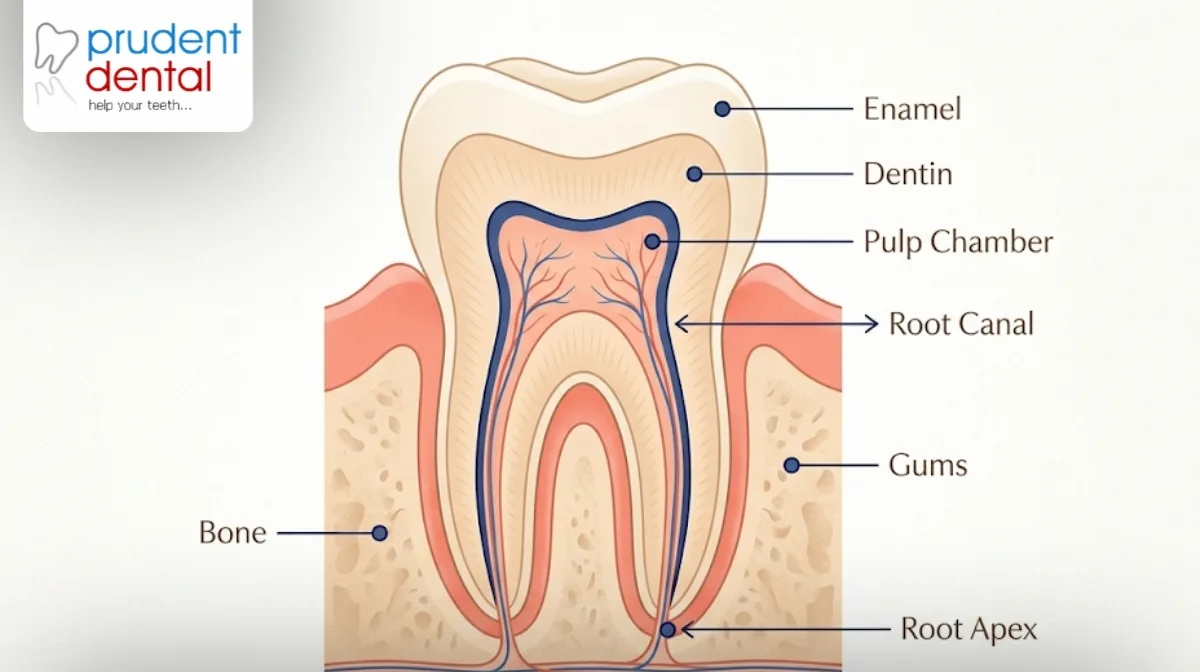
The appointment itself follows a consistent sequence: numbing the tooth, isolating it, removing the inflamed or infected pulp, cleaning and shaping the canals, and finally filling and sealing them. An X-ray taken beforehand maps the number and curvature of the canals, which is the main reason a single-canal front tooth is a shorter appointment than a three- or four-canal molar.
Do you need a crown after a root canal?
For most back teeth, yes. A crown after root canal treatment is commonly recommended. A root-treated tooth no longer has its pulp and can become more brittle over time, and molars absorb the heaviest chewing forces in the mouth. A well-made crown caps and protects the tooth so it can keep working for many years.
Until the final restoration is fitted, avoid chewing hard foods on the treated side. An unprotected root-treated tooth can crack under an unlucky bite. Once the crown is in place, care is ordinary: brush twice a day, clean between the teeth, and keep regular check-ups so the tooth and its restoration can be monitored. With good care, a root-treated and crowned tooth can serve you for many years.
If you have been putting off treatment because of the root canal's reputation, the most useful step is simply an examination and X-ray, so the decision is based on your tooth rather than on a myth. You can book a consultation any day of the week, and treatment is only planned after the findings have been explained to you.
Sources & further reading
Indian Dental Association · American Dental Association (MouthHealthy)
Root canal fears, answered
Tooth pain that will not settle? Ask about saving the tooth. Call +91 70287 22200.
Call +91 70287 22200 · Open 7 days, 9 AM–9 PM (5 PM Sun)