Key takeaways
- All-on-4 fixes a full arch of teeth on four implants, with the back pair tilted to use the bone you already have; All-on-6 uses six implants spaced along the jaw.
- All-on-6 spreads chewing load across more implants and adds reserve, but it needs more bone, especially towards the back of the jaw.
- All-on-4 often avoids bone grafting, which is why it suits jaws with long-standing bone loss after denture wear or missing molars.
- Neither option is universally better; the right choice depends on bone volume, bone density, bite and jaw anatomy seen on a CBCT scan.
- Suitability is confirmed only after an examination and imaging, and costs are given as a written itemised estimate, never a guess over the phone.
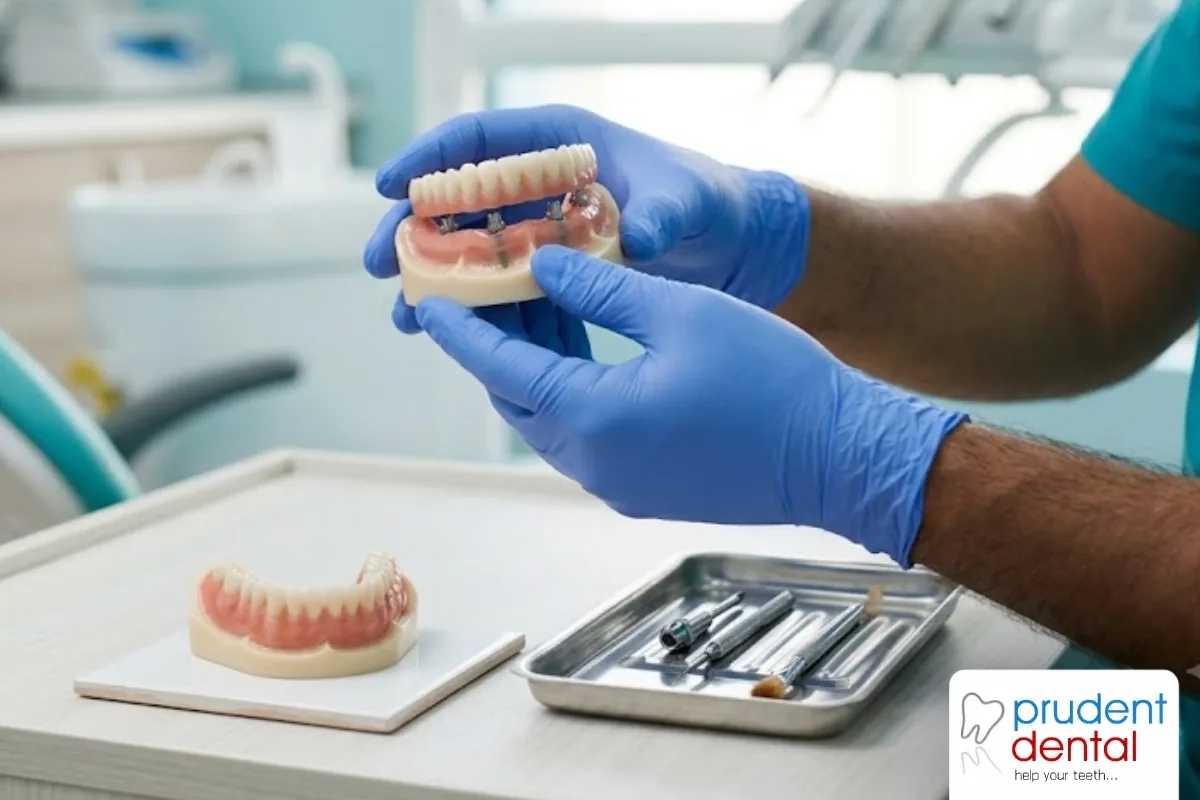
All-on-4 and All-on-6 are both ways of replacing a full arch of missing teeth with a fixed bridge held on a small number of implants, rather than one implant per tooth. The difference is what the names suggest: All-on-4 supports the new arch on four implants, with the back pair tilted to make the most of available bone, while All-on-6 spreads the same work across six implants placed more evenly along the jaw. All-on-6 distributes chewing load more widely but needs more usable bone, while All-on-4 is often chosen when bone at the back of the jaw has shrunk. Which one suits you is a clinical decision made after an examination and 3D imaging, not a matter of preference.
What full-arch implant treatment means
Full-arch rehabilitation replaces every tooth in the upper or lower jaw with a fixed bridge held on a small number of implants, so you get a complete set of teeth that does not come out at night and does not rest on the gums like a conventional denture. Both All-on-4 and All-on-6 belong to this family of treatments, and the surgical planning, healing and final bridge stages are broadly similar for each. If you are new to the idea, our overview of full mouth dental implants explains what the treatment involves from the first visit to the final bridge.
How All-on-4 works
All-on-4 places four implants in the jaw: two upright implants towards the front, and one on each side further back, deliberately tilted. Tilting the back implants lets the surgeon use the denser bone that usually remains at the front of the jaw while avoiding the sinus cavity in the upper jaw and the main nerve canal in the lower jaw. The full arch of teeth is then fixed to these four implants, with the tilted pair providing support further back than an upright implant could reach in the same bone.
The concept was developed for jaws that have lost bone at the back, which is common after years of wearing dentures or living with missing molars. Because the implants sit in bone that is already available, many patients can have All-on-4 without bone grafting or a sinus lift, which usually shortens overall treatment time. The trade-off is that four implants carry all of the chewing load, so case selection, implant positioning and the design of your bite have to be exact.
How All-on-6 works
All-on-6 supports the same style of fixed bridge on six implants spaced more evenly along the arch, usually including implants in the premolar and molar regions. With more supports under the bridge, each implant carries a smaller share of the chewing force and the bridge flexes less at the back. Dentists often prefer this configuration in the upper jaw, where bone tends to be softer, or when a patient has a strong bite, grinds or clenches, and the extra distribution of load is genuinely useful.
The requirement is bone. Those extra back implants need adequate height and width of bone to sit in, particularly below the sinus in the upper jaw. Where bone has shrunk, All-on-6 may still be possible after grafting or a sinus lift, but that adds surgical stages and healing time. In a jaw with good volume, however, six implants give a wide, stable platform, and there is more built-in reserve if one implant were ever to run into trouble.
All-on-4 vs All-on-6 at a glance
Neither design is simply better; they solve different problems. Think of the bridge as a table top: four well-placed legs can be perfectly stable, but six legs spread the weight further and forgive more. The comparison below is deliberately qualitative, because the deciding factors, such as bone volume, bone density and bite force, are measured for each patient rather than assumed. For the wider journey, from first scan through surgery to aftercare, our full mouth dental implants guide walks through each stage in plain language.
| Aspect | All-on-4 | All-on-6 |
|---|---|---|
| Implants per arch | Four, with the back pair tilted | Six, spaced more evenly along the jaw |
| Load distribution | Concentrated on fewer implants | Spread across more supports |
| Bone requirement | Works with limited bone at the back of the jaw | Needs more bone volume, especially in the molar region |
| Grafting | Often avoided, as tilted implants use existing bone | May need grafting or a sinus lift where bone is short |
| Typical situation | Long-standing bone loss, often after years of dentures | Good bone volume, softer upper-jaw bone, or a heavy bite |
| Surgical stage | Usually a shorter, simpler procedure | Somewhat longer, with more components placed |
| Reserve if one implant struggles | Less redundancy, needs prompt review | More redundancy built in |
How suitability is actually decided
No dentist can tell you whether you need All-on-4 or All-on-6 over the phone, and you should be wary of anyone who does. The decision rests on a clinical examination, a study of your bite and gum health, and a 3D CBCT scan that shows exactly how much bone exists, how dense it is, and where the sinuses and nerves run. At Prudent Dental Clinic in Viman Nagar, Dr. Puja Bansal leads every case and can call on consultant periodontist and implantologist Dr. Sumanth S. where his expertise helps, and the recommendation follows the scan, not a brochure.
Cost differs between the two mainly because of the number of implants, any grafting or sinus lift, the implant system chosen and the material of the final bridge, and we set this out in a written, itemised estimate after your examination rather than quoting a figure in advance. If your case involves severe bone loss that needs hospital-based reconstruction, we will say so honestly and refer you. A sensible first step is reading about whether you are a candidate for dental implants, then booking an assessment on +91 70287 22200.
- Bone height, width and density on a CBCT scan
- Position of the sinuses and the lower jaw nerve
- Gum health and any active infection
- Bite force, grinding or clenching habits
- General health, medications and healing capacity
All-on-4 vs All-on-6 implants FAQs
Sources & further reading: American Dental Association (MouthHealthy); NIDCR, US National Institute of Dental & Craniofacial Research; FDI World Dental Federation; Indian Dental Association.
Questions about your own teeth? Call +91 70287 22200.
Call +91 70287 22200 · Open 7 days, 9 AM–9 PM (5 PM Sun)