

Key takeaways
- String floss remains the most reliable way to clean between tightly touching teeth, but only with good technique.
- Water flossers are the better tool around braces, bridges and implants, and for anyone with limited dexterity.
- The tool you will actually use every day beats the theoretically superior one left in a drawer.
- Neither device removes tartar; hardened deposits need professional scaling and polishing.
- Persistent bleeding when cleaning between your teeth is a reason to see a dentist, not to stop cleaning.
String floss is still the benchmark for cleaning between teeth: it physically scrapes plaque off the tooth surface in a way a jet of water cannot fully match. A water flosser earns its place when floss is difficult or impossible, such as with braces, bridges, implants or limited hand dexterity, and it is genuinely good at flushing debris and calming inflamed gums. For many people the honest answer is both, used for different jobs. Whichever you choose, using it every day matters far more than the tool itself.
What each tool actually does
String floss works by direct contact. When you curve it around a tooth and slide it gently below the gumline, it physically scrapes the sticky film of plaque off the enamel and root surface. That scraping action matters because plaque is adherent: it does not simply rinse away. Floss also reaches the tight contact point where two teeth touch, a spot no brush and very little water pressure can clean properly. Done well, it cleans the two surfaces on every tooth that brushing always misses.
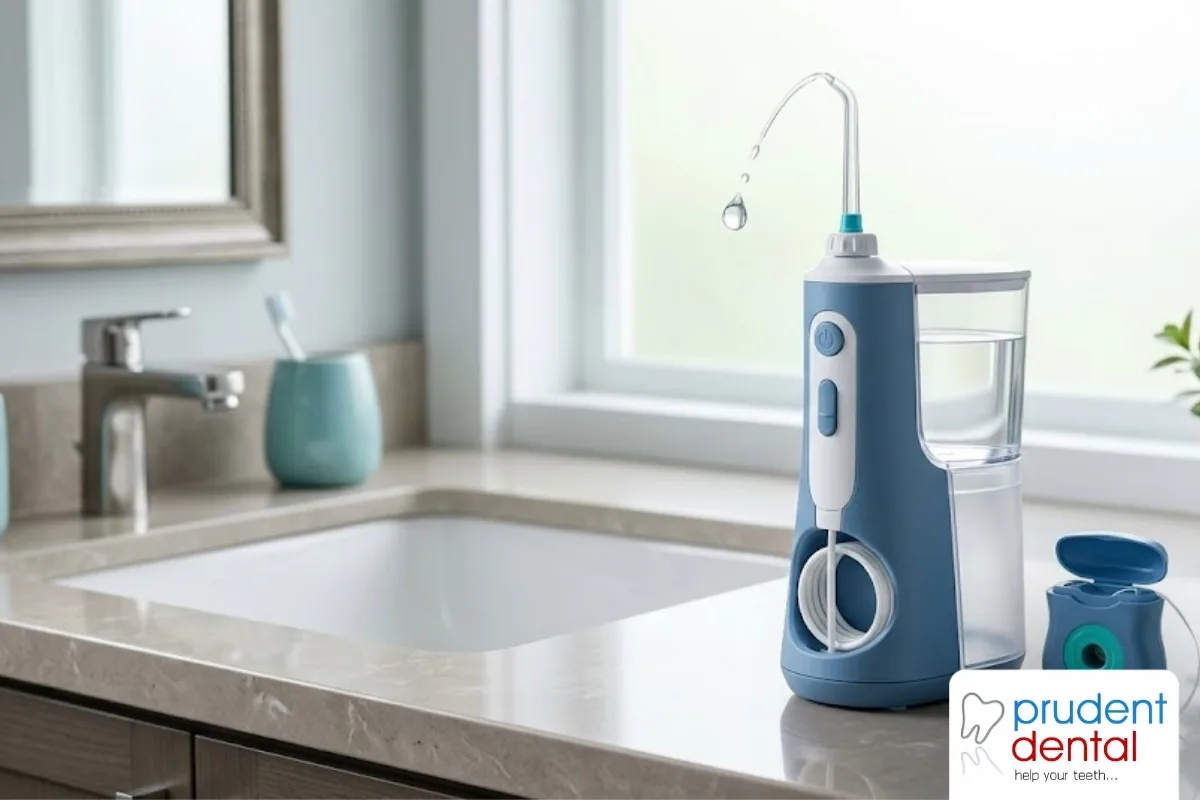
A water flosser, sometimes called an oral irrigator, fires a pulsating jet of water between the teeth and along the gumline. It flushes out food debris and loosely attached plaque, massages the gums and rinses areas that are physically blocked to floss, such as under a bridge or around an orthodontic wire. What it does less well is scrape. The jet disrupts plaque rather than wiping it off the tooth, so on plain, tightly spaced teeth it usually works best as a supplement rather than a full substitute.
What the evidence supports
Decades of research back daily interdental cleaning, and string floss is the tool most of that research was built on. Used correctly, it reduces plaque between the teeth and lowers the risk of gum inflammation and decay on those hidden surfaces. The caveat is technique: rushed, snapping floss that never hugs the tooth achieves very little, which is a large part of why results vary so much from person to person in studies and in real mouths.
Water flossers have solid evidence of their own, particularly for reducing gum bleeding and inflammation, and they perform well in people who struggle with string floss. Head to head comparisons are mixed, and no honest dentist will tell you one tool wins outright in every situation. What the research does show clearly is that the best interdental cleaner is the one you will actually use every day. A water flosser used every night beats perfect floss that stays in the drawer.
When a water flosser is clearly the better choice
There are situations where we actively recommend a water flosser, because string floss is either impractical or impossible. If you have gum disease with deeper pockets, an irrigator can flush areas floss cannot reach, and it works alongside professional periodontal care rather than replacing it. It is also kinder on tender, inflamed gums while they heal, which helps people keep cleaning the very areas that need it most.
- Fixed braces, where wires block normal flossing
- Bridges and joined crowns that floss cannot pass between
- Dental implants, where gentle cleaning around the gum margin matters
- Arthritis, tremor or anything else that limits hand dexterity
- Larger gaps or exposed root surfaces that trap food
- A strong gag reflex or difficulty reaching the back teeth
Side by side: an honest comparison
No single tool wins every category, which is exactly why this question has no one-line answer. The comparison below reflects what we see in practice, not marketing claims. Read it against your own mouth: your spacing, your dental work, your gum health and, honestly, your willingness to build a daily habit. Dr. Puja Bansal often settles the debate chairside simply by looking at which surfaces are collecting plaque and which tool a patient will realistically use.
| Situation | String floss | Water flosser |
|---|---|---|
| Plaque between tight contacts | The benchmark when technique is good | Helpful, but less direct scraping |
| Braces, bridges and implants | Fiddly, often needs threaders | Very well suited |
| Tender or bleeding gums | Effective but can feel harsh at first | Gentle and soothing |
| Dexterity required | Moderate to high | Low |
| Cost and travel | Inexpensive, fits in a pocket | Higher upfront cost, needs water and power |
| Sticking with the habit | Easy to skip | Many people find it easier to maintain |
Technique matters more than the tool
With floss, the movement that matters is the curve. Wrap the floss into a C shape against one tooth, slide it gently just below the gumline, sweep upwards, then repeat against the neighbouring tooth before moving on. Snapping the floss straight down bruises the gum and cleans almost nothing. With a water flosser, start on the lowest pressure, lean over the basin, and trace the gumline slowly, pausing briefly between each pair of teeth rather than waving the jet around the mouth.
Whichever tool you use, pair it with brushing twice a day and clean between your teeth once a day, ideally before your night-time brush so fluoride can reach freshly cleaned surfaces. If you are not sure whether your routine is actually working, our guide on how to remove plaque and tartar explains what you can manage at home, what the warning signs of trouble look like, and when professional help becomes necessary.
Where professional cleaning fits in
Neither floss nor a water flosser can remove tartar. Once plaque mineralises into that hard, chalky deposit, it bonds to the tooth, and only professional scaling and polishing can take it off safely. That is why home care and clinic care work as a pair: your daily routine keeps new plaque under control, and periodic cleaning resets the surfaces your tools cannot reach. If your gums bleed persistently despite good home care, book an examination rather than simply switching tools, because ongoing bleeding usually signals gum disease that needs proper assessment.
At Prudent Dental Clinic in Viman Nagar, Pune, we will happily look at your mouth and tell you plainly whether floss, a water flosser or both suits you, and demonstrate the technique on your own teeth. We are open seven days a week, and you can call +91 70287 22200 to book. There is no product to sell you here: the advice is matched to your dental work, your gum health and the habits you can realistically keep.
Water flosser vs dental floss FAQs
Sources & further reading: Cochrane Oral Health (evidence reviews); American Dental Association (MouthHealthy); NHS, Dental Health; World Health Organization, Oral Health.
Questions about your own teeth? Call +91 70287 22200.
Call +91 70287 22200 · Open 7 days, 9 AM–9 PM (5 PM Sun)