

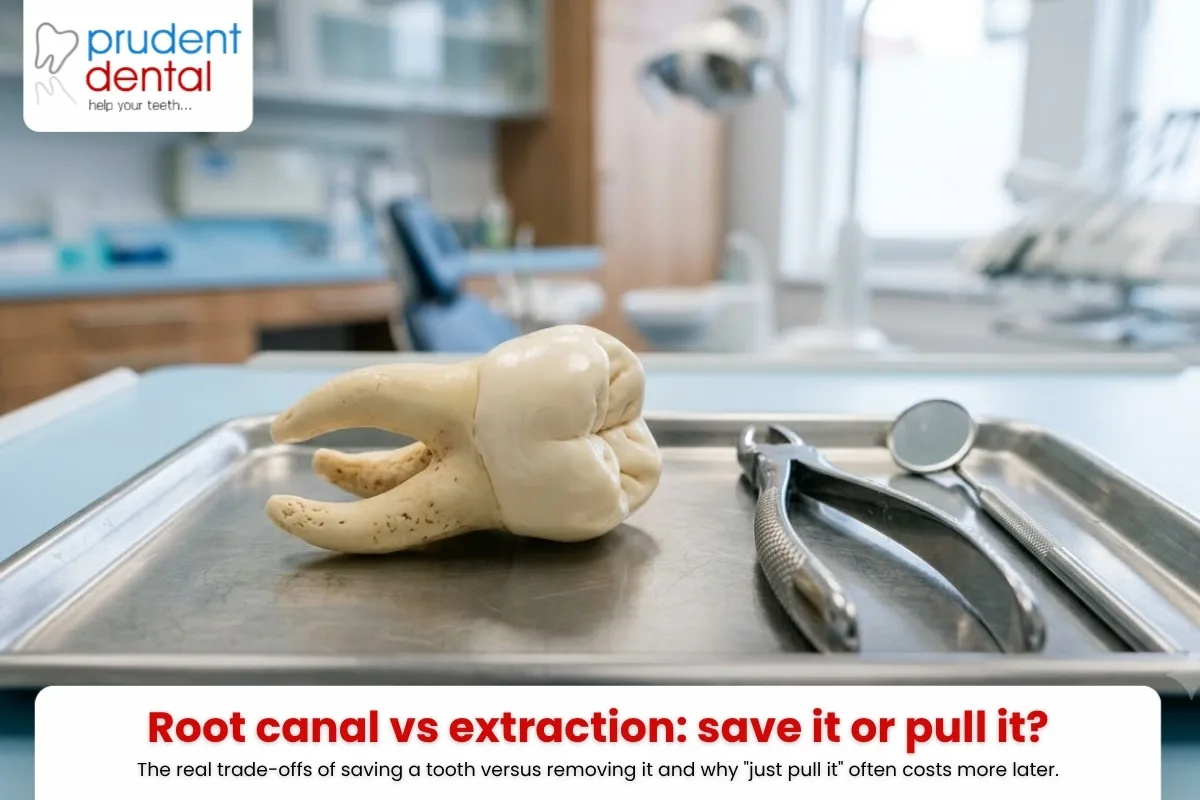
Key takeaways
- When a tooth can realistically be saved, a root canal is usually the better long-term choice than pulling it.
- A natural root keeps the jawbone stimulated and preserves your bite; a gap tends to cause neighbouring teeth to drift.
- Extraction is often cheaper on the day, but replacing the missing tooth later usually costs more than the root canal would have.
- Extraction is the right call when a tooth is cracked below the gum, too broken to rebuild, or loose from advanced gum disease.
When a tooth is badly infected or broken, it usually comes down to two roads: save it with a root canal, or remove it with an extraction. It is tempting to pick whichever sounds quicker or cheaper on the day, but that is often the wrong lens. The better question is what leaves your mouth healthiest in five years. Here is how a dentist thinks it through.
The default: save the tooth if you can
Modern dentistry leans towards keeping your natural teeth wherever it is realistic, and there is a good reason. Nothing replaces a natural tooth quite as well as the tooth itself. Its root sits in the jawbone, keeps that bone stimulated and preserves the natural way your teeth meet when you bite and chew. A root canal removes the infected pulp from inside the tooth while leaving that root in place, so the tooth stays and does its job.
An extraction solves the immediate problem quickly, but it creates a new one: a gap. And a gap is rarely the end of the story, which is the part that is easy to underestimate when a tooth is hurting and you just want it gone.
Why a gap is rarely just a gap
Teeth work as a set, each supported by its neighbours and its opposite number. Remove one and that balance shifts. Over months and years, the teeth on either side of the space tend to tilt into it, and the tooth in the opposing jaw can drift down or up towards the gap. That can unsettle your bite, create new spots that trap food, and make the teeth harder to clean.
The bone matters too. The bone that once held the root is no longer being used, and it slowly shrinks over time. That is why replacing a missing tooth, with a dental implant, a bridge or a denture, is usually recommended, and why the "just pull it" option is rarely as final as it sounds. Our guide to missing-tooth replacement options walks through what filling a gap involves.
The cost question, honestly
Cost is usually what tips people towards extraction, and on the day they are right: a simple extraction is cheaper than a root canal followed by a crown. But comparing only those two numbers is misleading. Once the tooth is out, the gap generally needs replacing to protect the rest of your mouth, and an implant or bridge typically costs more, sometimes considerably more, than the root canal and crown would have.
So the fuller comparison is not "cheap extraction versus expensive root canal". It is "root canal and crown now" versus "extraction now, plus a replacement later". Seen that way, saving the tooth is often the more economical path as well as the healthier one. We do not publish fixed prices, because the honest figure depends on your tooth; the point is simply to compare the whole journey, not just the first step. Our guide to what drives root canal cost explains the factors.
When extraction is genuinely the right choice
None of this means every tooth should be saved. Sometimes the sensible, honest decision is to remove a tooth, because trying to save one with a poor outlook wastes time and money and can store up problems. Extraction usually makes more sense when:
- The tooth is broken or decayed far below the gumline, with too little sound structure to rebuild
- There is a vertical crack running down through the root
- The tooth is loose because of advanced gum disease and bone loss
- Infection has damaged too much of the surrounding support to expect a lasting result
In these situations, removing the tooth and planning a proper replacement is often the better investment than a root canal that is unlikely to last. The judgement call, whether a tooth sits on the "savable" or "not worth saving" side of the line, is exactly what an examination is for.
How to make the decision well
| Consideration | Root canal (save) | Extraction (remove) |
|---|---|---|
| Best when | Tooth is restorable and worth keeping | Tooth is cracked, loose or too broken to rebuild |
| Natural tooth | Kept, root preserved | Lost, leaving a gap |
| Bite & bone | Maintained | Neighbouring teeth may drift; bone shrinks |
| Cost on the day | Higher (treatment plus a crown) | Lower for a simple extraction |
| Cost over time | Often lower overall | Replacement later usually adds more |
The right answer comes from an examination and an X-ray, plus an honest conversation about the tooth's outlook. A trustworthy dentist will tell you when a tooth is worth saving, when it is borderline, and when removing it is genuinely the wiser move, and will explain why rather than simply reaching for the forceps or the drill. It is entirely reasonable to ask, "Can this tooth be saved, and how likely is it to last?"
If you have a tooth in this situation, do not let it drift while you decide, because delay can quietly move a savable tooth into the "too late" category. You can book an appointment for a clear assessment of whether yours can be saved.
Sources & further reading
Indian Dental Association · American Dental Association (MouthHealthy) · NHS, Dental Health
Root canal or extraction: your questions answered
Facing a save-or-pull decision? Get an honest assessment. Call +91 70287 22200.
Call +91 70287 22200 · Open 7 days, 9 AM–9 PM (5 PM Sun)