Key takeaways
- The real question is usually not treat-or-not but save-or-replace: keep the tooth with a root canal, or remove it and place an implant.
- If a tooth can realistically be saved, keeping your natural tooth is usually the better first choice.
- An implant is the excellent answer when a tooth is genuinely beyond saving, not a shortcut to replace a savable one.
- Longevity and cost both depend on your specific tooth; the decision needs an examination and an X-ray, not a guess.
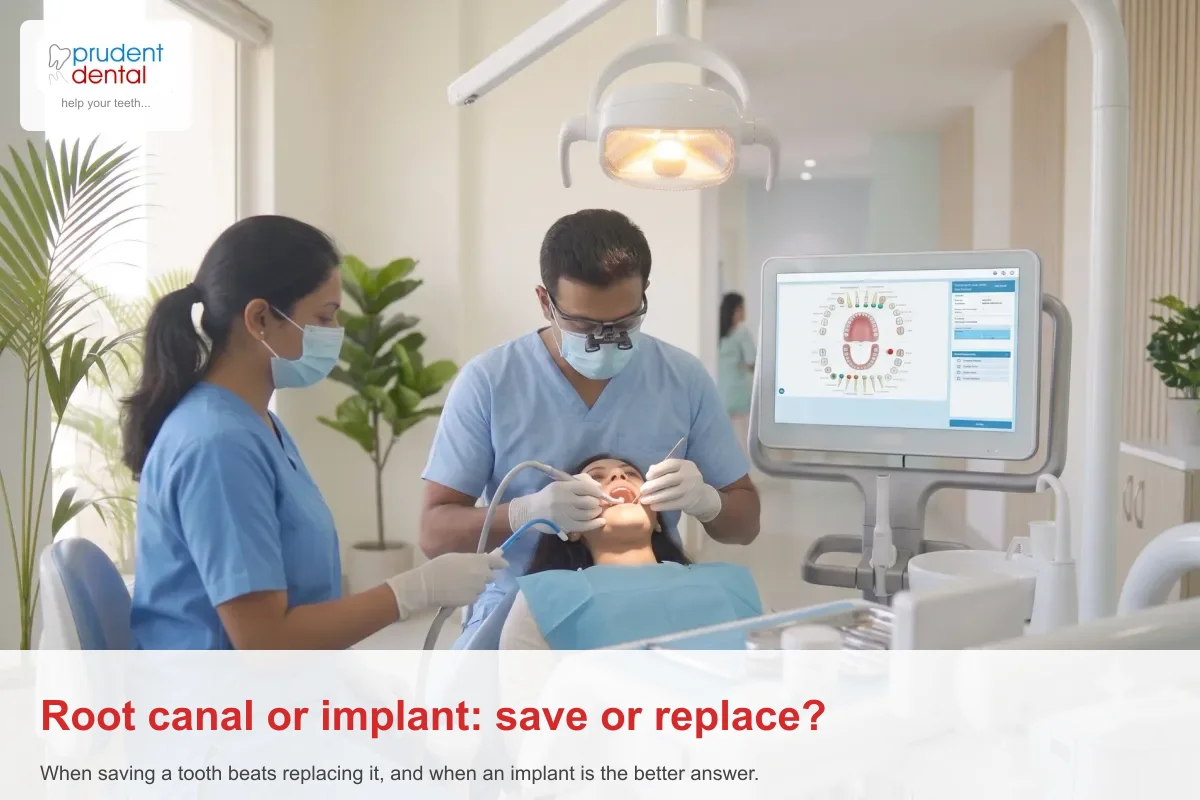
When a tooth is badly damaged or infected, the choice is sometimes framed as a straight contest: root canal or implant? Both are strong, lasting solutions, so it is worth understanding what the decision really turns on. This is a save-versus-replace question, and it is different from the earlier fork of whether to treat a tooth at all. If you are weighing up saving a tooth against pulling it, our guide to root canal versus extraction covers that ground; here we compare saving the tooth against replacing it with an implant.
First: can the tooth realistically be saved?
Everything starts here, and it is the honest question a good dentist asks first. If the tooth can be predictably restored, saving it is usually the default, because a natural tooth that stays put is hard to improve on. If it cannot be predictably saved, the question largely answers itself, and a replacement such as an implant becomes the sensible route. So the comparison below only really applies to a tooth that genuinely could go either way.
The case for saving it: root canal and crown
A root canal removes the infected or damaged tissue from inside the tooth while leaving the root in place, and a crown afterwards protects what remains. Keeping your own tooth has real advantages: nothing replaces a natural tooth quite as well as itself, the root keeps the surrounding bone stimulated, there is no surgery to remove the tooth and rebuild the site, and it is usually completed in fewer visits and less overall time than extracting and placing an implant. A root-canal-treated tooth that is well restored and cared for can serve you for many years.
The case for an implant
When a tooth is genuinely not worth saving, a dental implant is the closest thing to a natural tooth. A titanium post replaces the root and a crown sits on top, standing on its own without affecting the neighbouring teeth and keeping the bone stimulated where the root used to be. Implants have a strong long-term track record and can last a very long time with good care. The trade-off is that you do lose the natural tooth, it involves minor surgery, and it takes several months to complete while the post fuses with the bone.
Save vs replace, side by side
| Consideration | Root canal (save) | Implant (replace) |
|---|---|---|
| Your natural tooth | Kept, root preserved | Removed, replaced by a post and crown |
| Surgery | None to remove the tooth | Minor surgical procedure |
| Time to complete | Usually fewer visits, less overall time | Usually several months |
| Neighbouring teeth | Untouched | Untouched |
| Longevity | Many years when well restored and cared for | Many years with healthy gums and bone |
| Best when | The tooth can be predictably restored | The tooth is beyond saving |
Longevity and cost, honestly
It is tempting to decide on longevity or price alone, but both depend on the specifics. A well-done root canal with a crown can last many years, and so can an implant; neither is guaranteed forever, and the outcome depends on the tooth, the bone, and how well it is looked after. On cost, saving a tooth is often less than extracting it and placing an implant, but the only honest figure is one given after an examination. We do not publish fixed prices, because a single number would mislead for a decision this individual. The sensible approach is to compare written estimates for the whole journey, not just the first appointment.
The honest rule of thumb
If a tooth can be predictably saved, saving it is usually the better first choice, and an implant is the excellent answer when it cannot. Removing a savable tooth to replace it with an implant, simply to have the matter finished, is rarely the wiser move. Which side your tooth falls on is a genuine clinical judgement that needs an examination and an X-ray, plus an honest conversation about the outlook. You can book an appointment for a clear assessment of whether yours can be saved.
Sources & further reading
American Dental Association (MouthHealthy) · NIDCR, US National Institute of Dental & Craniofacial Research · NHS, Dental Health · Indian Dental Association
Root canal or implant: your questions answered
Not sure whether to save or replace a tooth? Get an honest assessment. Call +91 70287 22200.
Call +91 70287 22200 · Open 7 days, 9 AM–9 PM (5 PM Sun)