Key takeaways
- Removable dentures are affordable and non-surgical, but they can move while eating and need relining as the jaw changes shape
- Fixed options, whether bridges or implant-supported teeth, stay put and chew almost like natural teeth, but they need strong anchor teeth or adequate bone
- Only implants help preserve the jawbone; a conventional denture cannot stop the slow shrinkage that follows tooth loss
- An implant-retained overdenture is a sensible middle ground when a loose lower denture is the main complaint
- Bone volume and budget decide much of the choice, so an examination and a written itemised estimate come before any recommendation
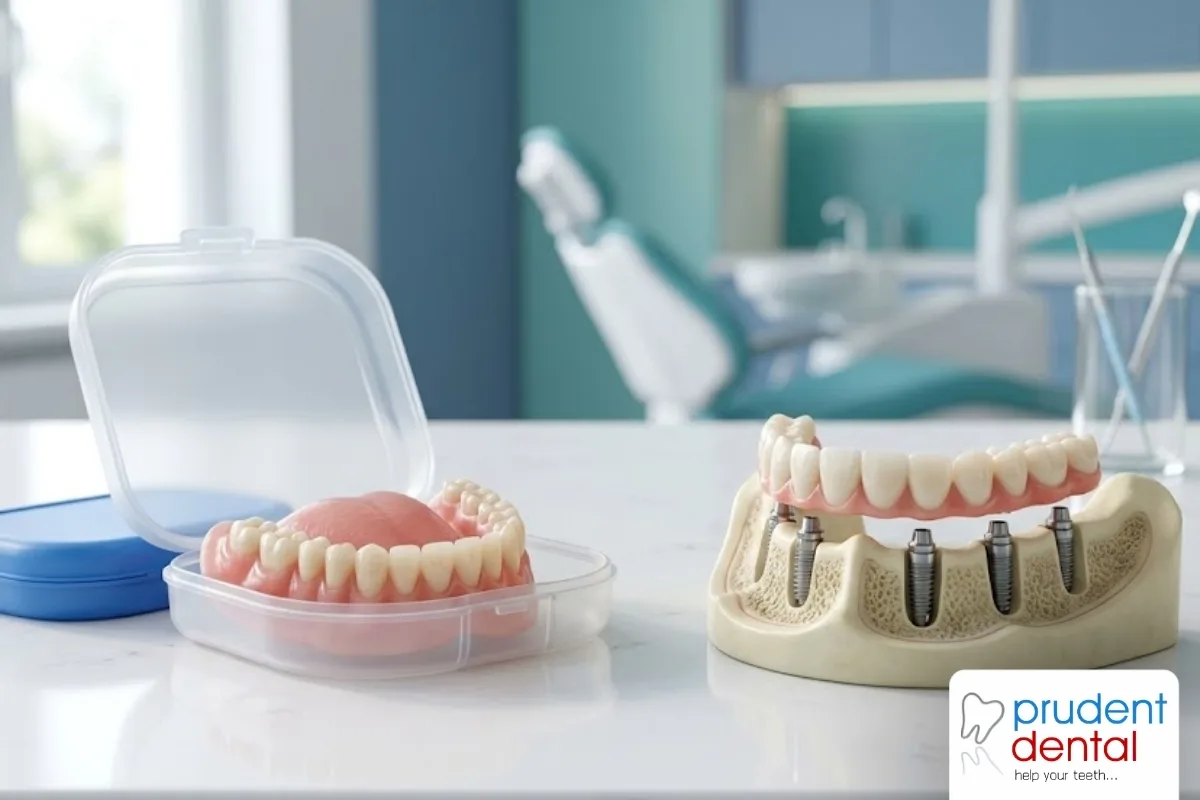
If you have lost most or all of your teeth, there are two broad paths back to a working smile: removable dentures that you take out to clean, or fixed teeth that stay in your mouth, meaning bridges or implant-supported prostheses. Removable dentures are gentler on the budget and involve no surgery, while fixed options score higher on stability, chewing power and long-term bone preservation. Neither is universally better; in practice your jawbone volume, general health and budget decide much of the choice. This guide compares the two honestly so you can walk into a consultation knowing which questions to ask.
How removable dentures work
A removable denture replaces missing teeth with an acrylic base or a cast metal framework that rests on your gums and, in the upper jaw, part of the palate. A complete denture restores a whole arch, while a partial denture fills gaps and clips onto your remaining natural teeth. At Prudent Dental Clinic, our dentures and prosthesis work is planned by Dr. Puja Bansal, who has 27 years of experience, so the fit, bite and appearance are checked at every stage rather than left to the laboratory alone.
The appeal is practical. Dentures need no surgery, they suit patients whose health makes implant placement unwise, and they remain the quickest and most affordable way to restore a full smile. The trade-offs are equally real: lower complete dentures in particular can shift while eating, some hard or sticky foods stay difficult, and because the jawbone slowly changes shape underneath, most dentures need relining or remaking every few years to keep fitting well.
Fixed options: bridges and implant-supported teeth
A fixed bridge suits smaller gaps. The teeth on either side of the space are shaped and crowned, and the replacement tooth is anchored between them, so nothing comes out of your mouth. It works well when the neighbouring teeth are strong, though it involves trimming healthy enamel and it cannot replace a full arch. Cleaning under the bridge with floss threaders or interdental brushes becomes part of your daily routine, because food and plaque collect beneath the false tooth.
When most or all teeth are missing, implants carry the load instead. Titanium posts are placed in the jaw and, once healed, support crowns, bridges or a complete fixed arch. Our full mouth dental implant cases are planned jointly by Dr. Puja Bansal, who holds a certificate course in oral implantology, and consultant periodontist and implantologist Dr. Sumanth S., whose 25 years of experience cover both implant placement and the gum health that keeps implants alive. Fixed implant teeth feel closest to natural teeth in stability and chewing, but they need adequate bone, healthy gums and a surgical healing period that typically runs a few months.
The middle ground: implant-retained overdentures
If a full fixed arch is out of reach, an overdenture is worth asking about. A small number of implants carry attachments that your denture clips onto, so it snaps firmly into place yet still comes out for cleaning at night. Stability usually improves dramatically compared with a conventional lower denture, which is where loose dentures cause the most frustration, and the implants also give the bone some of the stimulation it needs. The denture component still wears and needs periodic maintenance, but for many patients this option balances comfort, cleaning ease and cost better than either extreme.
How they compare day to day
The differences show up less in the dental chair and more at the dinner table and the bathroom sink. Fixed teeth win on stability and chewing confidence, while removable dentures win on simplicity, easy repairs and lower upfront commitment. Bone preservation is the quiet long-term factor many patients only hear about later: implants stimulate the jaw the way tooth roots once did, whereas a conventional denture rests on the gum and cannot stop the slow shrinkage that follows tooth loss.
| Aspect | Removable denture | Fixed bridge or implant teeth |
|---|---|---|
| Stability | Can move, especially lower complete dentures; adhesive sometimes needed | Firmly anchored; no movement in normal use |
| Eating | Softer diet at first; hard and sticky foods stay tricky | Usually near-normal chewing once healing is complete |
| Daily care | Removed and brushed after meals, left out at night | Brushing plus interdental cleaning around implants or under the bridge |
| Bone preservation | Does not stop bone shrinkage, so the fit changes over the years | Implants stimulate and help preserve bone; a tooth-supported bridge does not |
| Adaptation | A few weeks of practice with speech and eating; sore spots adjusted | Surgical healing first, then feels close to natural teeth |
| Maintenance | Relines and remakes every few years | Regular reviews and attachment servicing; the teeth on top can still need renewal from wear |
What actually decides it: bone, budget and health
Honestly, the decision is rarely about preference alone. Implants need enough bone volume, which we assess through an examination and scans; long-standing tooth loss or gum disease often reduces it, and some patients need grafting first. General health matters too, since uncontrolled diabetes, heavy smoking and certain medications can affect healing. Budget is the other frank consideration. Fixed implant work costs more upfront but is a long-term investment, while removable dentures cost less initially yet carry recurring reline and replacement costs. We explain the factors behind denture costs in Pune separately, and you always receive a written itemised estimate after your examination, never a quote over the phone.
The practical next step is a consultation at our Viman Nagar clinic, where Dr. Puja Bansal examines your mouth, reviews scans where needed and talks you through every workable option, including the less expensive ones. We are open seven days a week, Monday to Saturday from 9AM to 9PM and Sunday from 9AM to 5PM, so appointments can fit around work. Call +91 70287 22200 to book. There is no pressure to decide on the day; most patients go home with a written estimate and time to think it over.
- A removable denture often suits you if you want a non-surgical, lower-cost solution, or your health makes implant surgery unwise
- A fixed bridge suits a small gap flanked by strong natural teeth
- Implant-supported fixed teeth suit you if you have adequate bone, healthy gums and want the closest thing to natural teeth
- An implant-retained overdenture suits you if a loose lower denture is the problem but a full fixed arch is beyond budget
- Complex jaw or hospital-level surgical cases are referred honestly to the right specialist
Fixed vs removable dentures FAQs
Sources & further reading: American Dental Association (MouthHealthy); NIDCR, US National Institute of Dental & Craniofacial Research; NHS, Dental Health; Indian Dental Association.
Questions about your own teeth? Call +91 70287 22200.
Call +91 70287 22200 · Open 7 days, 9 AM–9 PM (5 PM Sun)