

Key takeaways
- Pick the tooth up by the crown only; never touch or scrub the root.
- The best place for a knocked-out adult tooth is back in its own socket; milk is the next best.
- Aim to reach a dentist within 30 minutes; the root cells start dying as soon as the tooth dries.
- Never reimplant a baby tooth; it can damage the permanent tooth developing underneath.
- Call +91 70287 22200 while travelling so the clinic can prepare before you arrive.
A knocked-out permanent tooth can often be saved, but usually only if you act within the first half hour. Pick the tooth up by the crown, never the root, rinse it gently if dirty, and place it back into its socket if you can. If that is not possible, keep it moist in milk or saliva and get to a dentist immediately. Baby teeth are the exception: they should never be pushed back in.
The first five steps, in order
Dentists call a fully knocked-out tooth an avulsed tooth, and it is one of the few true dental emergencies where seconds count. The single biggest mistake people make is handling the root or letting the tooth dry out. Follow the steps below exactly as written, in order, and keep moving towards a dentist while you do them. Ask someone to phone ahead so the clinic can prepare.
- 1. Find the tooth and pick it up by the crown, the white part you chew with. Never touch the root.
- 2. If it is dirty, rinse it for a few seconds in milk or cold running water. Do not scrub it, do not use soap and do not wrap it in tissue.
- 3. Reimplant it if you can: ease it back into the socket the right way round, then bite gently on a clean handkerchief to hold it in place.
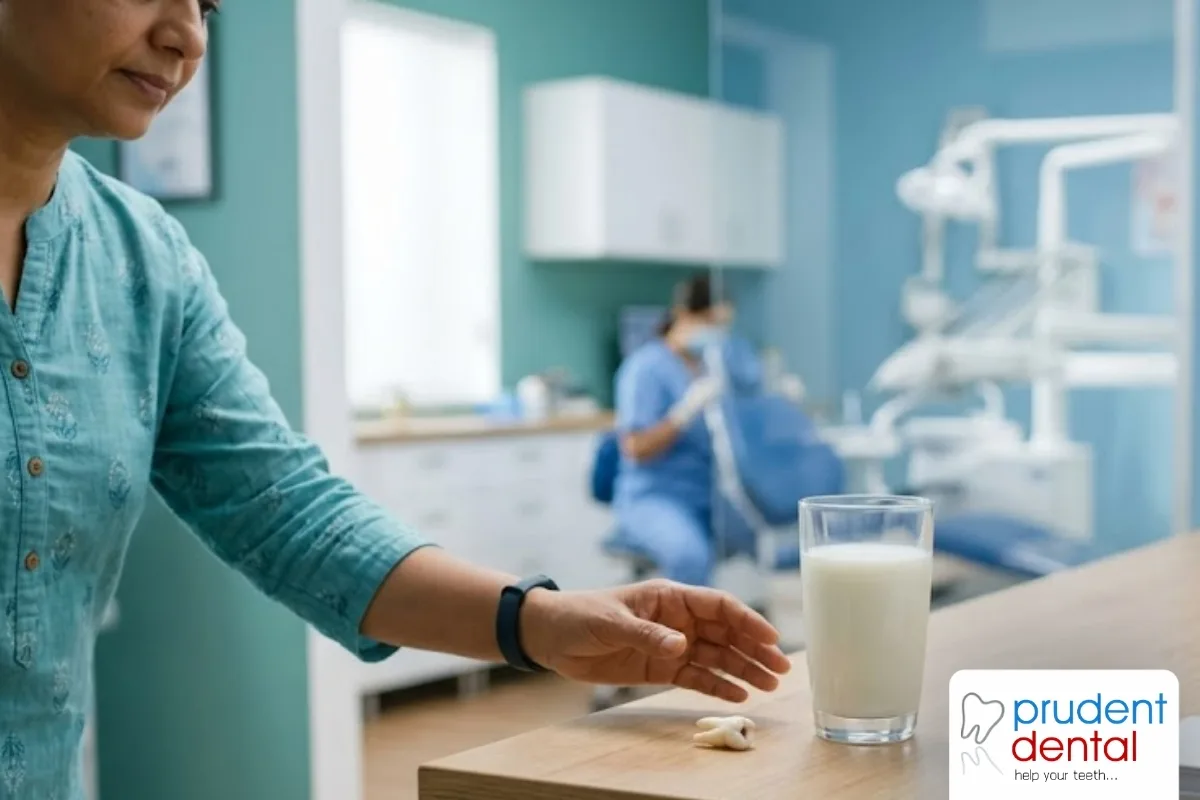
- 4. If you cannot reimplant it, drop it into a small container of milk, or keep it inside the cheek in the injured person's own saliva (adults only, never children).
- 5. Get to a dentist immediately, ideally within 30 minutes. Call ahead so the team can prepare before you arrive.
Why the first 30 minutes decide everything
The root of every adult tooth is covered in a thin layer of living cells called the periodontal ligament. These cells are what allow a reimplanted tooth to reattach to the jaw, and they begin to die within minutes once the tooth dries out. A tooth replanted quickly, or kept moist in milk, often reattaches well. A tooth that has been dry for an hour rarely does, however skilfully it is treated afterwards.
This is why you should travel and phone at the same time rather than waiting to be seen. Prudent Dental Clinic in Viman Nagar is open seven days a week, so call our emergency dentist in Pune on +91 70287 22200 while you are on your way. Describing what happened in advance lets the team prepare the splinting materials before you walk through the door.
How to store the tooth if you cannot put it back
Not everyone can face pushing a tooth back into its socket, and sometimes swelling or other injuries make it impossible. In that case the storage medium becomes the deciding factor. The goal is to keep the root cells alive and moist in something close to the body's own fluids. Milk is the practical winner in most Indian households: it is usually to hand, cool and chemically gentle on the root surface.
| Storage option | Verdict | Why |
|---|---|---|
| Back in its own socket | Best | Keeps the root cells in their natural environment while you travel |
| Plain milk | Very good | Close to body fluids and usually available within seconds |
| Saliva, inside the cheek | Acceptable for adults | Moist and at body temperature, but never for children, who may swallow the tooth |
| Saline solution | Acceptable | Useful if a first-aid kit happens to be nearby |
| Tap water | Poor | Damages the root cells; use only as a brief rinse, not for storage |
| Dry tissue or a pocket | Worst | Drying kills the ligament cells within minutes |
Baby teeth are the exception: never reimplant them
If a child knocks out a milk tooth, do not push it back in, however intact it looks. The developing permanent tooth sits just beneath the socket, and reimplanting a baby tooth can damage that bud, causing the adult tooth to erupt discoloured, misshapen or not at all. A reimplanted milk tooth can also fuse to the bone or become infected. It is a hard instinct to override, but the kindest thing is to leave it out.
The child still needs to be seen promptly. A dentist will check that the whole tooth came out, that no fragment is left in the gum, and that neighbouring teeth and the jaw are undamaged. At Prudent Dental Clinic these cases are examined by Dr. Vanessa Lobo, our consultant paediatric dentist with an MDS in Paedodontics and Preventive Dentistry, who also advises parents on managing the gap until the permanent tooth arrives.
What happens at the clinic, and afterwards
If the tooth is back in its socket, the dentist confirms its position, takes an X-ray and splints it to the neighbouring teeth with a thin flexible wire, usually for around two weeks. If you arrive with the tooth in milk, it is gently cleaned and replanted first. Most reimplanted adult teeth later need root canal treatment, because the nerve inside rarely survives the injury, and our consultant endodontist Dr. Mrunal Godse handles that stage. Regular reviews follow to check the root is healing rather than being resorbed.
Sometimes a tooth cannot be saved, because it was found too late, stored dry or badly damaged. That is disappointing but not the end of the story: once the socket has healed over a few months, the gap can usually be restored with a dental implant, planned by Dr. Puja Bansal, who leads every case at the clinic. For other urgent situations, from severe toothache to a broken tooth, our guide on what to do in a dental emergency walks you through the same calm, stepwise approach.
When to go to a hospital first
A knocked-out tooth often comes with a bang to the head or face, and some situations outrank the tooth. Go to a hospital emergency department first, and deal with the tooth afterwards, if any of the following apply. Prudent Dental Clinic refers complex facial injuries honestly to maxillofacial and hospital colleagues, because a dental chair is not the right place for them.
- Loss of consciousness, however brief, or any confusion, vomiting or drowsiness after the injury
- Bleeding that does not slow with firm pressure after several minutes
- A suspected broken jaw: the teeth no longer meet properly, or the mouth cannot open or close
- Deep facial cuts that may need stitches
Knocked-out tooth FAQs
Sources & further reading: NHS, Dental Health; American Dental Association (MouthHealthy); NIDCR, US National Institute of Dental & Craniofacial Research; Indian Dental Association.
Questions about your own teeth? Call +91 70287 22200.
Call +91 70287 22200 · Open 7 days, 9 AM–9 PM (5 PM Sun)