

Key takeaways
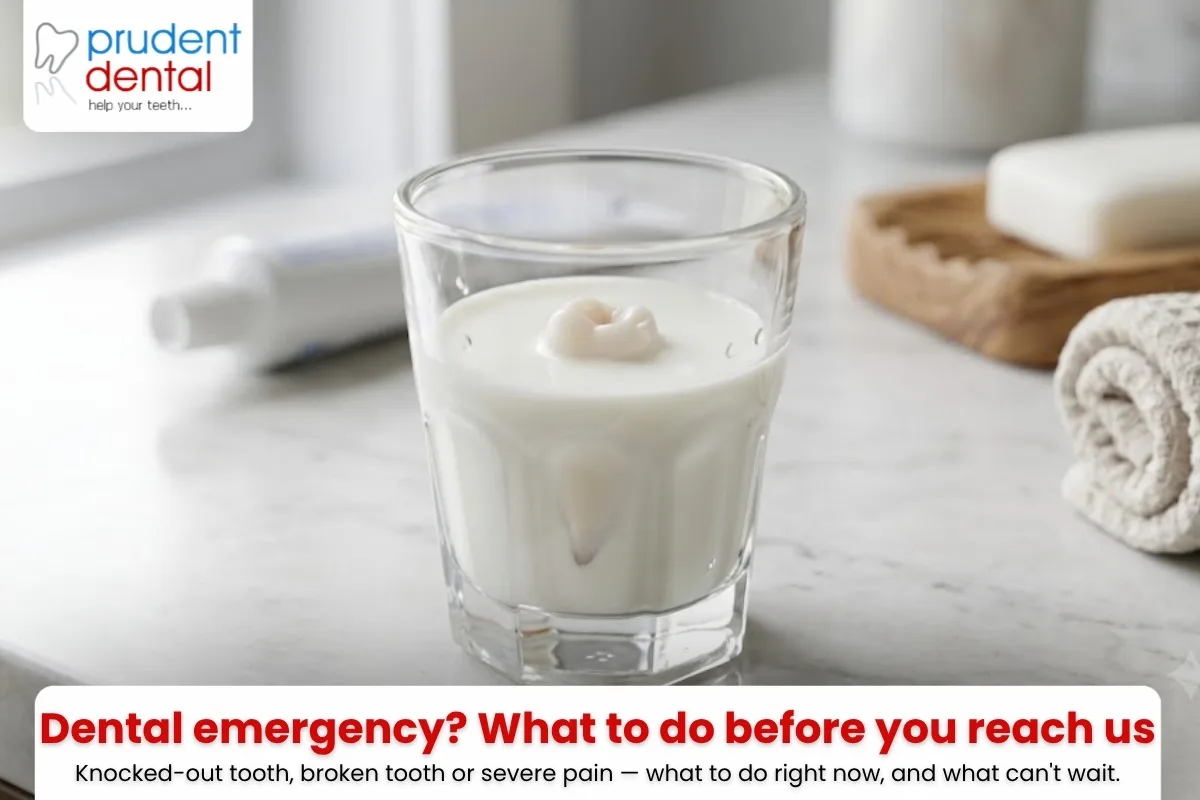
- A knocked-out tooth is the most time-critical emergency. Handle it by the crown, keep it in milk, and get to a dentist within 30 to 60 minutes.
- For a broken tooth, save the pieces, rinse gently, control bleeding, and protect the sharp edge until you are seen.
- Facial swelling with fever, or swelling that affects breathing or swallowing, is a medical emergency. Go to a hospital.
- When in doubt, call. It is always better to phone a dentist and be reassured than to wait on a problem that gets worse.
Dental emergencies are frightening precisely because they happen suddenly and you rarely know what to do in the moment. The good news is that a few simple, correct actions in the first minutes can genuinely change the outcome, especially with a knocked-out tooth. This guide is a calm, practical reference for the common emergencies and exactly what to do before you reach a dentist. It is general first-aid information, not a substitute for being seen.
A knocked-out (avulsed) tooth, act within the hour
This is the one emergency where minutes truly matter. A permanent tooth that has been completely knocked out can often be saved and put back, but the chance drops sharply with every passing half hour. Here is what to do:
- Find the tooth and hold it by the crown, the white part you normally see. Never touch or scrub the root, as the delicate cells on it are what allow it to reattach.
- If it is dirty, rinse it gently for a few seconds in milk or saline (not tap water if avoidable), without scrubbing or drying it.
- Try to put it back in the socket the right way round and bite gently on a clean cloth to hold it. This is the best place for it.
- If you cannot re-insert it, keep it moist, in a cup of cold milk, or tucked inside the cheek. Do not let it dry out and do not wrap it in tissue.
- Get to a dentist immediately, ideally within 30 to 60 minutes.
One important exception: a knocked-out baby tooth should not be put back, because doing so can damage the developing adult tooth underneath. Keep the child calm, control any bleeding, and see a dentist to check the area.
A broken, chipped or cracked tooth
Rinse your mouth with warm water and save any fragments you can find. If the gum is bleeding, press a clean piece of gauze on it for a few minutes. A cold pack held against the cheek reduces swelling and numbs the area, and a sharp edge can be covered with orthodontic wax or a piece of sugar-free gum so it does not cut your tongue. Take whatever pain relief you would normally use, avoid chewing on that side, and see a dentist soon. Even a tooth that does not hurt can be cracked beneath the surface, so it is worth having checked before it becomes painful.
Severe toothache or a dental abscess
A severe, throbbing toothache, especially with swelling, a bad taste or a fever, often means infection, and infection does not settle on its own. While you arrange to be seen, rinse with warm salt water, keep your head raised, and use your usual pain relief. Do not place aspirin directly on the gum, and do not try to lance any swelling yourself. Our guide on what to do about a toothache at night covers safe relief in more detail.
A dental abscess needs professional treatment, and the warning signs below mean you should not wait.
When to treat it as a medical emergency
Most dental problems can wait for an urgent dental appointment. A few cannot. Go to a hospital immediately if you have any of these:
- Facial or neck swelling that is spreading, or swelling near the eye.
- Difficulty breathing or swallowing.
- A high fever alongside dental swelling.
- Heavy bleeding that will not stop with firm pressure.
- A dental injury that came with a blow to the head, blackout or neck pain.
These are uncommon, but they are the situations where a dental infection or injury becomes genuinely dangerous, and prompt medical care matters.
A lost filling or crown
This is usually urgent rather than a true emergency. Keep the crown safe if you still have it, avoid chewing on that side, and keep the tooth clean. You can buy a temporary dental cement from a pharmacy to cover a sensitive tooth for a day or two, but never use superglue or household adhesives. A dentist can often simply re-cement an undamaged crown.
Get seen quickly
For anything painful, bleeding or broken, the safest step is simply to call. At Prudent Dental Clinic in Viman Nagar, Pune, we are open seven days a week from 9 AM to 9 PM (5 PM on Sundays), so there is a good chance we can see you the same day. See our emergency dentist in Pune page, call +91 70287 22200 or find our location and directions. If it is outside our hours and you have any of the medical-emergency signs above, go straight to your nearest hospital.
Sources & further reading
Indian Dental Association · NHS, Dental Health · American Dental Association (MouthHealthy)
Dental emergency FAQs
Dental emergency? Call +91 70287 22200 now. We are open 7 days, 9 AM to 9 PM (5 PM on Sundays).
Call +91 70287 22200 · Open 7 days, 9 AM–9 PM (5 PM Sun)