

Key takeaways
- An implant replaces the root as well as the crown, so it is the only option that helps preserve the jawbone.
- A bridge is fixed and quicker, but healthy neighbouring teeth must be trimmed to support it.
- A denture is the least invasive and most economical route, especially for multiple missing teeth, but it needs the most daily care.
- Leaving a gap untreated lets neighbouring teeth drift and bone shrink, which can limit your options later.
- The right choice depends on your bone, gums, neighbouring teeth and budget, so an examination and a written itemised estimate come first.
If you have lost a tooth, there are three main ways to replace it: a dental implant, a fixed bridge or a removable denture. An implant replaces the root as well as the crown, which is why it helps protect the jawbone and usually lasts the longest. A bridge is quicker and avoids surgery but relies on the neighbouring teeth for support, while a denture is the least invasive option and often the most practical when several teeth are missing. The right choice depends on your bone and gum health, the condition of the neighbouring teeth, your budget and your own preference, which is why an examination comes first.
How each option replaces a missing tooth
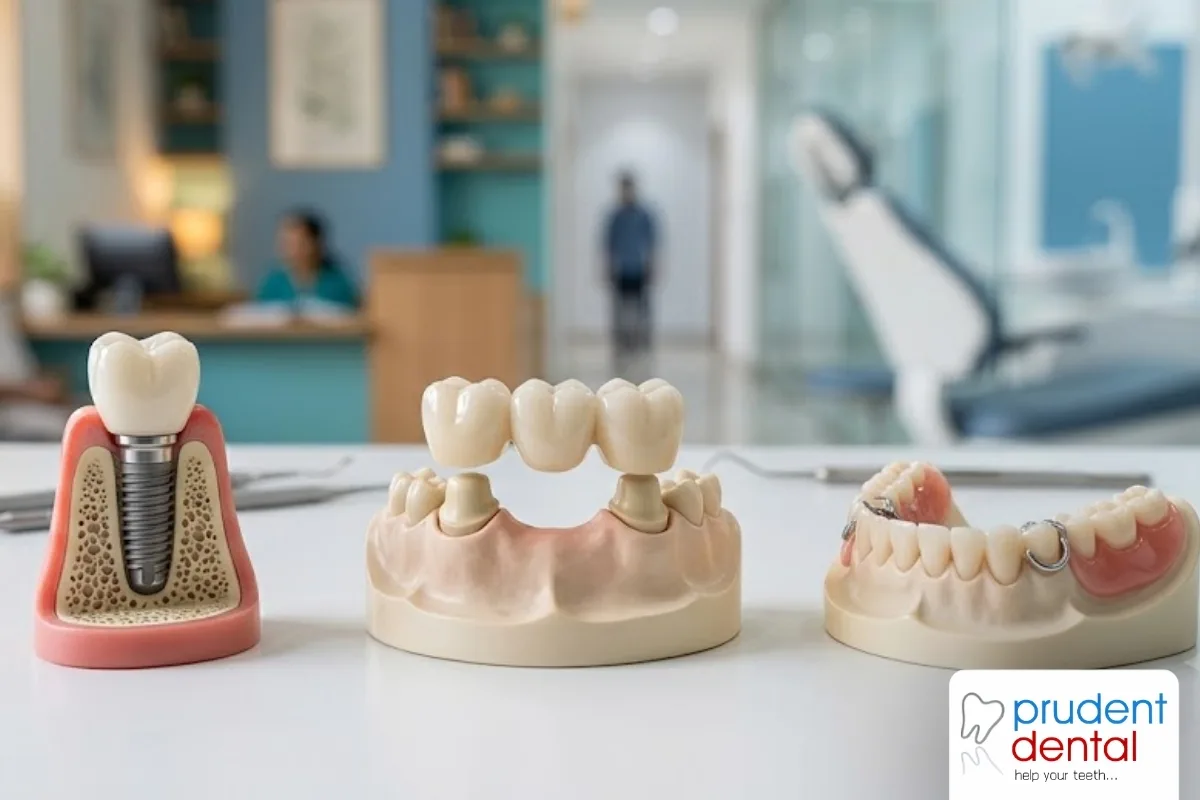
A dental implant is a small titanium post placed in the jaw where the root of the missing tooth used to be. Over the following months the bone bonds to the post, a process called osseointegration, and a crown is then fixed on top. Because the implant stands on its own support, the neighbouring teeth are left completely untouched. At our Viman Nagar clinic, dental implants are planned by Dr. Puja Bansal, who has completed a certificate course in oral implantology, working alongside consultant periodontist and implantologist Dr. Sumanth S.
A fixed bridge closes the gap by anchoring an artificial tooth to crowns cemented onto the teeth on either side. Those supporting teeth are reshaped to accept the crowns, which means healthy enamel is removed even if the teeth were otherwise sound. The result is fixed in place, feels close to natural teeth and can usually be completed in a few visits. You can read more about how we design and fit them on our crowns and bridges page.
A removable denture is a plate carrying one or more artificial teeth that rests on the gums, sometimes with clasps around remaining teeth for grip. It involves no surgery and no drilling of neighbouring teeth, and it remains the most economical route when many teeth are missing. Modern dentures are lighter and better fitting than older designs, though they still need to be removed for cleaning and often feel different from natural teeth, especially at first.
What happens to your bone and neighbouring teeth
This is the difference most people never hear about. When a tooth is lost, the jawbone in that area no longer receives chewing stimulation and gradually shrinks. An implant is the only option that transmits chewing force into the bone the way a root does, which helps preserve its height and width. Bridges and dentures replace the visible tooth but not the root, so slow bone loss under the gap usually continues, and a denture may need relining or remaking as the ridge changes shape.
Neighbouring teeth matter just as much. A bridge asks two, sometimes more, healthy teeth to carry extra load after being trimmed for crowns, and if one of those anchor teeth later develops decay or fracture, the whole bridge can be affected. An implant leaves the neighbours alone entirely. A denture is gentle on adjacent teeth in the short term, but a poorly fitting one can rock against them and against the gums, so regular reviews are important whichever option you choose.
The three options at a glance
The table below compares the three options on the points patients ask about most. It is deliberately qualitative: how long any restoration lasts in your mouth depends on your gum health, your bite, your cleaning habits and whether you attend reviews. Treat it as a starting point for a conversation rather than a verdict, because the right answer for a single missing front tooth is often different from the right answer for a full arch.
| Factor | Dental implant | Fixed bridge | Removable denture |
|---|---|---|---|
| Surgery needed | Yes, a minor procedure under local anaesthetic | No | No |
| Neighbouring teeth | Left untouched | Trimmed to support the anchor crowns | Largely untouched; clasps may rest on them |
| Jawbone preservation | Best; stimulates bone like a natural root | Bone under the gap still shrinks slowly | Bone continues to shrink; fit changes over time |
| Feel and chewing | Closest to a natural tooth | Fixed and stable | Takes adjustment; may move slightly |
| Treatment time | Longest; healing typically takes a few months | Usually a few visits | Usually a few visits |
| Daily care | Brushed and cleaned like a natural tooth | Needs special cleaning under the false tooth | Removed and cleaned separately each day |
| Longevity | Often the longest lasting with good care | Good, but depends on the anchor teeth staying healthy | Shortest; usually needs relining or replacement sooner |
| Typically suits | Healthy gums with adequate bone | Neighbouring teeth that already need crowns | Multiple missing teeth, or when surgery is unsuitable |
Comfort, eating and daily maintenance
Implants and bridges are fixed, so eating usually feels secure from early on and there is nothing to take out at night. An implant crown is cleaned exactly like a natural tooth: brushing twice a day and cleaning between the teeth. A bridge needs one extra habit, threading floss or using an interdental brush under the false tooth, because food trapped there is a common reason bridges fail early. Neither option is maintenance free; the gum around an implant can become inflamed just as it can around a natural tooth.
Dentures ask more of you day to day. They are removed after meals for rinsing, cleaned separately with a soft brush, and left out overnight so the gums can rest. Lower dentures in particular can move while eating until the tongue and cheeks learn to steady them, and speech may take a little practice at first. Most wearers adapt well, but if a denture still feels loose or sore after the adjustment period, it needs professional attention rather than more fixative.
- Clean any replacement tooth and the gum line around it twice a day
- Use interdental brushes or floss threaders under a bridge every day
- Remove dentures at night and store them clean and moist
- Book a review promptly if anything feels loose, sore or keeps trapping food
Who each option suits
Implants suit people with healthy gums, adequate bone and the patience for a longer treatment journey, since healing typically takes a few months before the final crown is fitted. They are usually the first recommendation for a single missing tooth in an otherwise healthy mouth, precisely because they spare the neighbours. Smokers, people with uncontrolled diabetes and those with significant gum disease need these issues assessed and managed first, which is where the input of our consultant periodontist is particularly valuable.
Bridges make particular sense when the teeth beside the gap are already heavily filled or crowned, because they would benefit from crowns anyway and little healthy tooth is sacrificed. They also help people who cannot or prefer not to have surgery, or who want a fixed result without a surgical stage. Dentures come into their own when several teeth are missing across the arch, when bone loss makes other options difficult, or when budget is the deciding factor for now.
These categories overlap in real mouths, and combinations are common: implants can support bridges, and a denture can be a planned interim step while bone heals after an extraction. If you are still weighing things up, our broader guide to missing tooth replacement options walks through timing, what happens if you delay, and what to expect at a first consultation.
Deciding with your dentist in Viman Nagar
Cost naturally shapes this decision, and it is honest to say the three options sit at different levels. What each will cost you depends on how many teeth are being replaced, whether bone grafting or extractions are needed first, the materials chosen for the crown or denture teeth, and how much preparatory gum treatment is required. We do not quote figures without seeing you; after an examination and any necessary X-rays you receive a written, itemised estimate so you can compare your options calmly at home.
One point of urgency is worth stating plainly: the longer a gap is left, the more the neighbouring teeth drift and the opposing tooth over-erupts into the space, which can narrow your choices later. If a tooth has recently been removed, or a gap has started trapping food or aching, book an assessment soon rather than waiting. Dr. Puja Bansal leads every case at Prudent Dental Clinic, the clinic is open seven days a week, and you can call +91 70287 22200 to arrange a consultation.
Implant vs bridge vs denture FAQs
Sources & further reading: Indian Dental Association; American Dental Association (MouthHealthy).
Questions about your own teeth? Call +91 70287 22200.
Call +91 70287 22200 · Open 7 days, 9 AM–9 PM (5 PM Sun)