Key takeaways
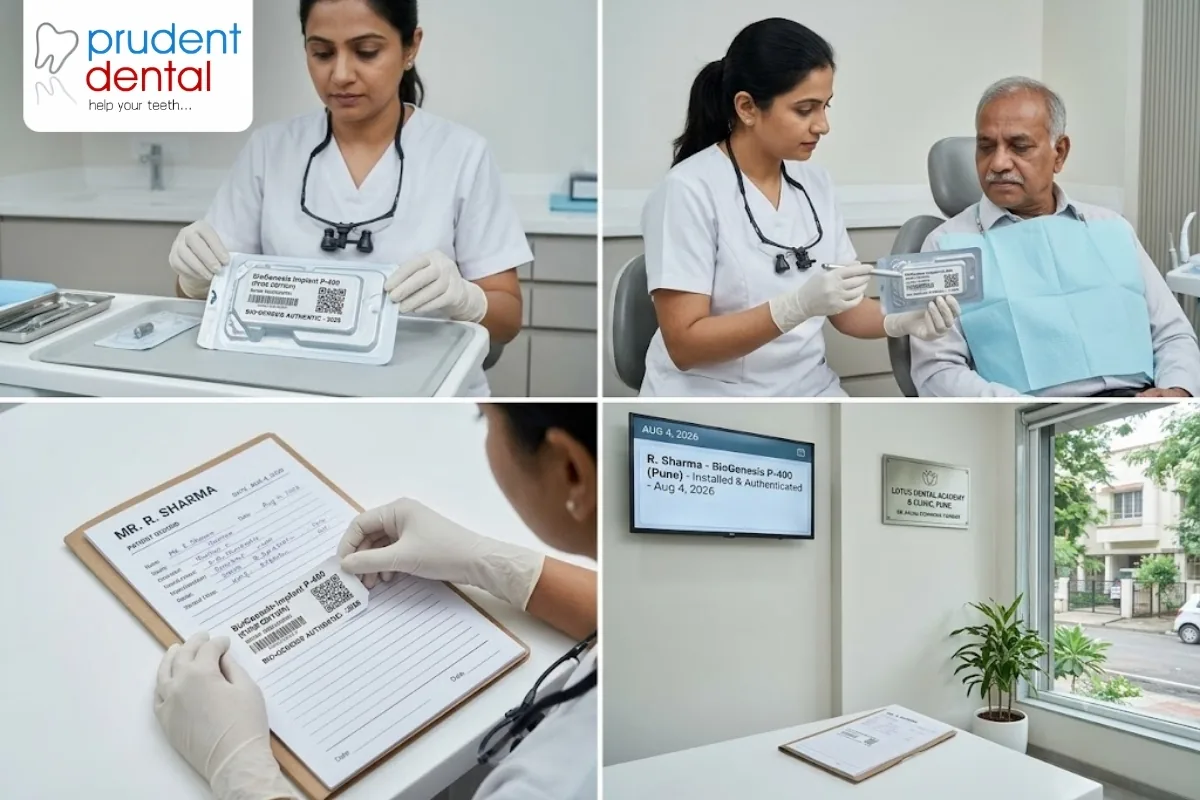
- Every certified implant arrives in sealed, sterile packaging with a printed label showing the manufacturer, product reference and a batch or lot number.
- Ask your dentist by name which implant system they use, and why. A clear, confident answer is itself a reassuring sign.
- Prefer an established system with published long-term research and dependable local supply of matching parts, so future repairs stay simple.
- You are entitled to a copy of the implant label or "passport" for your records. A good clinic offers it without being pushed.
The tooth you can see is only half of a dental implant. The other half is a small post living quietly inside your jaw, meant to stay there for years. It is fair to want to know exactly what that post is, who made it, and whether it is a genuine, certified system. Here is how to check, in plain language, without needing to be an engineer.
How do I know my dental implant is genuine?
Ask which implant system will be used, then ask to see the label or "passport" that comes with it. A genuine, certified implant arrives in sealed, sterile packaging carrying the manufacturer name, a product reference and a batch or lot number. Your dentist can record these in your file and give you a copy.
Think of that label the way you would think of the paperwork for any serious medical device. It is not decoration. It is traceability. If a manufacturer ever issued a notice about a particular batch, that lot number is how your specific dental implant could be identified and matched back to you. A system that cannot be traced offers you none of that protection, no matter how convincing the final crown looks in the mirror.
None of this requires you to distrust your dentist. It is simply the same reasonable due diligence you would apply to any procedure meant to last decades. A clinic that works with authentic systems has nothing to hide here, and will usually be glad you asked.
How to check an implant brand is certified?
Look for three things: an established system with published, long-term research behind it, clearance to be sold and used in India, and dependable local supply of matching parts. You are not judging one brand against another. You are confirming the system is real, documented and supportable where you live.
It helps to understand why these three points matter, so here is what each one actually protects.
- Documented research. Established systems have years of published clinical study behind them. That track record is what lets a dentist plan realistically. Brand-new or obscure systems may work, but the long-term evidence simply is not there yet, and you carry that uncertainty.
- Regulatory clearance. Implants are regulated medical devices. A legitimate system is authorised for sale and clinical use through the proper channels, rather than sourced informally. This is a baseline, not a luxury.
- Local support and spare parts. An implant is a two-part device: the post in the bone and the components that attach to it. If a connector or crown ever needs replacing, matching parts must be available. Choosing a system with reliable supply in India keeps future repairs straightforward instead of a hunt.
- A dentist who can explain the choice. Ask why this system was selected for your case. A considered answer, whether the clinic standardises on one trusted system or works with a few, tells you the decision was deliberate.
You do not have to verify all of this alone. Much of it comes straight from an honest conversation with your dentist, which is one reason choosing the clinic carefully matters so much. Our guide on how to choose a good dentist in Pune walks through the wider checklist of credentials, sterilisation and technology.
What implant brand does my dentist use?
Just ask, directly, before treatment starts. It is a normal question, and a good dentist will name the specific system, explain why they use it, and tell you whether they rely on one trusted system or a small, chosen set. A clear answer is reassuring. A vague or defensive one is worth gently pressing on.
To make that conversation easy, here is a short comparison of the answers that tend to reassure against the ones that should prompt a follow-up question. This is about openness and traceability, never about labelling any particular product good or bad.
| What to ask | A reassuring answer | Worth clarifying further |
|---|---|---|
| Which system? | Names the specific system and manufacturer without hesitation | "A good imported one" with no name given |
| Can I see the label? | Happy to show the sealed pack and note the batch or lot number | Reluctance, or no traceable packaging on offer |
| Is there research behind it? | Points to an established, well-documented system | Cannot say, or the system is brand-new and unknown |
| Are spare parts available here? | Explains how matching components are sourced locally | Unsure whether parts could be obtained in future |
| Why this system for me? | Gives a considered, case-specific reason | Treats the question as an inconvenience |
Remember the goal. You are not trying to catch anyone out. You are confirming that the device going into your body is genuine, documented and supportable, which is exactly what a careful clinic wants for you too. Keeping the label with your records also makes any future check-up or crown replacement smoother.
At Prudent Dental Clinic in Viman Nagar, Pune, implant treatment is led by Dr. Puja Bansal (BDS), an implantologist with 27 years of experience and Maharashtra State Dental Council registration A8860. You are welcome to ask which system is planned for your case and why, and to request the implant label for your file. If you would like to talk it through, you can book a consultation; the clinic is open seven days a week, 9 AM to 9 PM (5 PM on Sundays), on +91 70287 22200. Every mouth is different, so the right system and plan can only be settled after a proper examination and X-ray.
If you are looking at a bigger case, our 2026 guides to full mouth dental implants and same-day implants cover full-arch and immediate-load treatment in depth.
Sources & further reading
Indian Dental Association · World Health Organization, Oral Health
Verifying your implant, answered
Want to know exactly which implant system is right for you? Call +91 70287 22200.
Call +91 70287 22200 · Open 7 days, 9 AM–9 PM (5 PM Sun)