Key takeaways
- Baking soda removes some surface stain through mild scrubbing, so teeth can look a little brighter. It does not bleach or change the tooth’s natural colour.
- It is relatively gentle used occasionally, but hard scrubbing or daily use can wear enamel over time.
- Never mix it with lemon juice or vinegar. Adding acid turns a mild remedy into an enamel-stripping one.
- Plain baking soda has no fluoride, so it should not replace your normal toothpaste. For a real shade change, professional whitening is safer and works better.
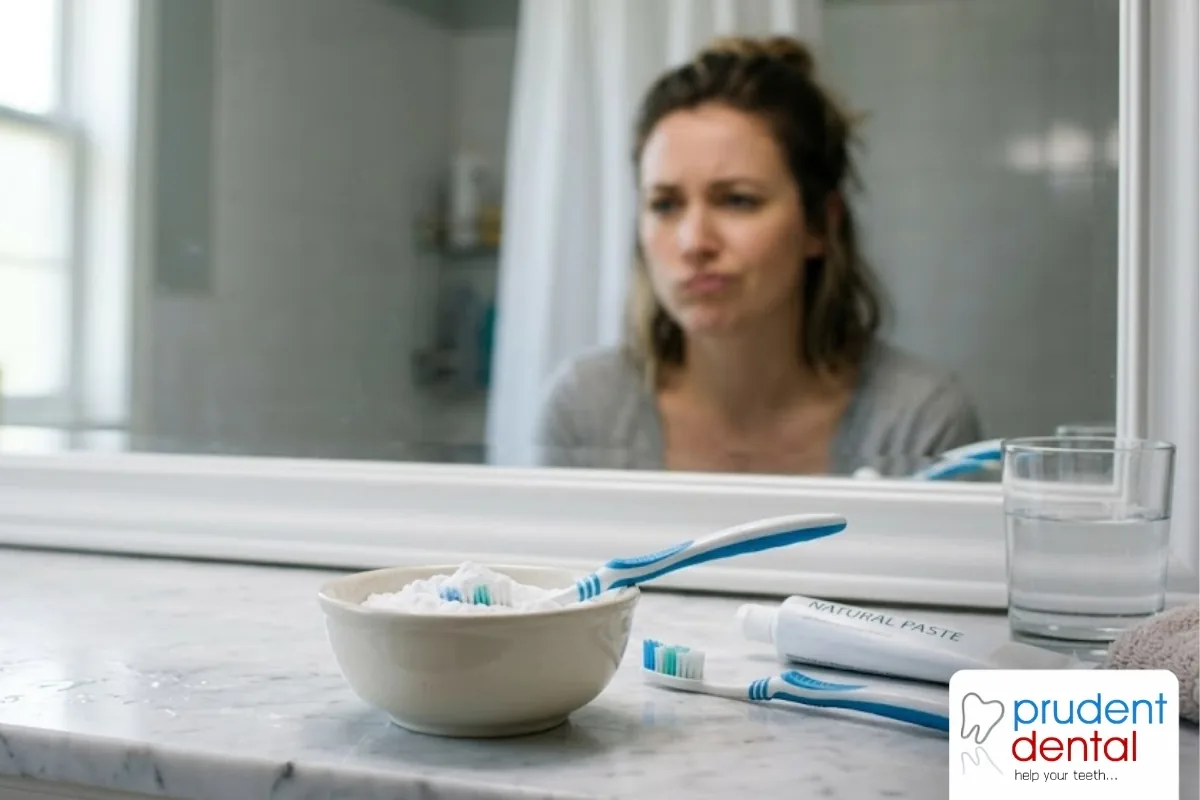
Baking soda is one of the oldest home remedies for a brighter smile, and it keeps trending online with recipes that promise dramatic results. So does it work, and is it safe? The honest answer is somewhere in the middle: it does a little, it is not the miracle the videos suggest, and a few popular versions of the trick can quietly damage your teeth.
Here is a dentist's straight take on what baking soda actually does to your enamel, when it is reasonably safe, and the mistakes worth avoiding.
Does baking soda whiten teeth?
Baking soda, or sodium bicarbonate, is a very fine mildly abrasive powder. When you brush with it, those soft crystals scrub away some of the stained film that collects on the enamel from tea, coffee, tobacco and richly coloured food. Remove that surface layer and the tooth underneath looks a shade cleaner. That is the whole mechanism.
Notice what it does not do. It does not bleach the tooth, and it does not touch the natural colour of the dentine inside, which is what gives many teeth their yellow tone in the first place. So baking soda is a stain remover, not a true whitener. If your teeth are yellow because of thinning enamel or built-in colour rather than surface stain, and we explain that difference in why are my teeth turning yellow, baking soda will do very little.
Is it safe for your enamel?
This is where the nuance matters. On the scale dentists use to rate how abrasive a cleaning product is, baking soda on its own is actually fairly gentle, gentler than some charcoal pastes people assume are natural and therefore safe. Used lightly and now and then, it is unlikely to harm healthy enamel.
The trouble starts with how people use it. Scrubbing hard, using it every single day, or making a gritty thick paste turns a mild abrasive into a wearing one. Enamel does not regenerate, so any that is worn away is gone for good, and thinner enamel shows more yellow dentine, which defeats the purpose. Plain baking soda also contains no fluoride, the mineral that actively strengthens enamel and fights decay, so using it in place of toothpaste leaves your teeth less protected.
The mistake that really damages teeth
If you take one thing from this article, let it be this: never mix baking soda with lemon juice, vinegar or any other acid, no matter how many recipes suggest it. The idea sounds clever, a fizzing reaction that seems to lift stains, but acid softens and dissolves enamel, and scrubbing softened enamel with an abrasive strips it away far faster. It is one of the more reliable ways to cause permanent, irreversible wear on your teeth at home.
The same caution applies to the other viral whitening hacks. Charcoal, in particular, gets marketed as a gentle natural option when it can be quite abrasive. We cover that one in is charcoal toothpaste safe.
If you still want to use it
Baking soda is not forbidden, it just needs sensible limits. If you like using it, keep it occasional, once or twice a week at most, apply it with a light touch rather than scrubbing, and always keep using a normal fluoride toothpaste for your everyday brushing so your enamel keeps its protection. Stop if your teeth start feeling sensitive, which can be an early sign of wear.
The genuinely effective route to a brighter smile
For most people who want a real, visible change rather than a marginal one, the reliable path is simple. Start with a professional scaling and polishing, which removes hardened tartar and stubborn stain that no home method reaches. If you want to go further, dentist-supervised teeth whitening lightens the natural tooth shade in a controlled way, with the strength adjusted to your teeth and your sensitivity. It is faster, more predictable and far kinder to your enamel than any powder from the kitchen.
At Prudent Dental Clinic in Viman Nagar, Pune, we are happy to tell you honestly what will and will not brighten your particular teeth, so you do not waste time or risk your enamel on a hack. The clinic is open seven days a week from 9 AM to 9 PM (5 PM on Sundays), and you can book a consultation online or call.
Sources & further reading
Indian Dental Association · American Dental Association (MouthHealthy) · NHS, Dental Health
Baking soda and whitening FAQs
For whitening that is safe for your enamel, call +91 70287 22200 to book.
Call +91 70287 22200 · Open 7 days, 9 AM–9 PM (5 PM Sun)