Key takeaways
- Charcoal toothpaste is abrasive. Regular use can wear away enamel, and enamel does not grow back.
- Most charcoal toothpastes contain no fluoride, so they give up proven protection against cavities.
- Charcoal only scrubs surface stains. It cannot bleach teeth, and thinning enamel can make teeth look yellower over time.
- The safer route to a whiter smile is a professional cleaning first, then dentist-supervised whitening if you still want a lighter shade.
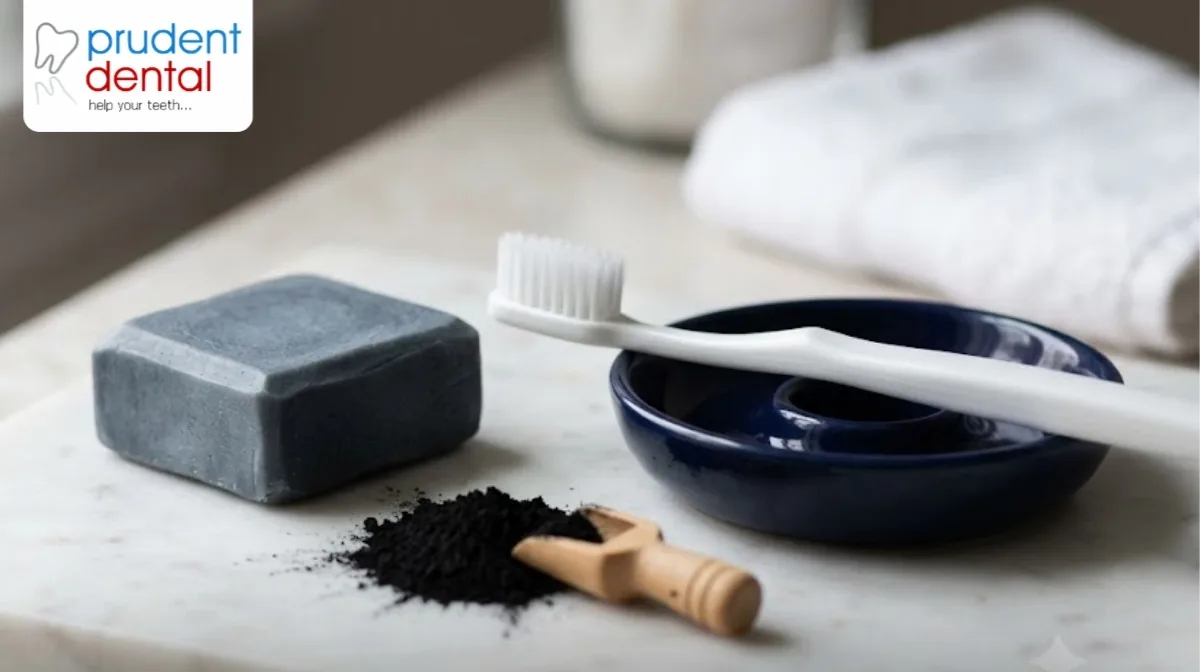
Black toothpaste is one of the most heavily marketed oral-care trends of recent years. It promises a "detox" and a whiter smile in a single tube. Activated charcoal really is good at binding to substances (that is why hospitals use it for certain poisonings), but that chemistry does not translate into safe or effective tooth whitening. Here is what charcoal toothpaste actually does inside your mouth, and what a dentist would suggest instead if you want a visibly brighter smile.
Is charcoal toothpaste safe?
Charcoal toothpaste is not a safe everyday choice for most people. The fine charcoal particles that create its scrubbing action are abrasive, and brushing with them daily can gradually wear away enamel. Most charcoal formulas also contain no fluoride, so they give up proven cavity protection. Occasional use is unlikely to harm, but dentists generally advise against routine use.
The main concern is abrasion. Enamel is the hardest tissue in the human body, but it is thin and it does not regenerate. Toothpastes vary widely in how abrasive they are, and charcoal powders tend to sit towards the harsher end of the range. Combine an abrasive paste with a firm brush and vigorous scrubbing, and the enamel near the gumline, where it is thinnest, wears fastest. That wear often shows up first as new sensitivity to cold drinks.
Fluoride is the second problem. Most charcoal toothpastes are sold without fluoride, and some even advertise this as a feature. Fluoride is still the best-evidenced everyday defence against tooth decay. If a charcoal paste replaces your regular toothpaste, you are brushing twice a day while giving up that protection. Some researchers also question whether charcoal particles can bind fluoride inside the tube itself, weakening its effect even in the formulas that do include it.
There is a housekeeping issue too. Fine charcoal grit can collect along the gum margin and in the microscopic gaps around fillings, crowns and veneers, sometimes leaving greyish lines. Major dental organisations have not endorsed charcoal toothpaste. Published reviews of the research have repeatedly concluded that there is not enough evidence to support the safety and whitening claims printed on the packaging.
Does charcoal whiten teeth?
Charcoal can remove some surface stains left by tea, coffee and tobacco, so teeth may look marginally brighter for a while. It does not bleach the tooth, and it cannot lighten the internal colour of enamel or dentine. Any whitening effect is just mechanical stain removal, a job a professional cleaning does more thoroughly and more safely.
Tooth discolouration comes in two forms. Extrinsic stains sit on the surface: the residue of tea, coffee, red wine, tobacco and strongly coloured foods. Intrinsic discolouration lives within the tooth structure itself and deepens naturally with age. Charcoal can only scrub at the first kind. It contains no bleaching agent, so it has no way to change the underlying shade of the tooth, which is usually what people actually notice in the mirror.
Worse, the mechanism can backfire over time. Enamel is pale and slightly translucent, and the dentine underneath it is naturally yellow. As abrasive brushing thins the enamel, more of that yellow dentine shows through, so teeth scrubbed in pursuit of whiteness can gradually look darker instead. A roughened enamel surface also picks up fresh stains more readily, which tempts people to scrub even harder. A gentle professional cleaning avoids that cycle.
Charcoal also does nothing to lighten fillings, crowns or veneers, and abrasive pastes can dull their polished surfaces. If you have visible dental work on your front teeth, an abrasive whitening product can quietly worsen the colour match rather than improve it.
What is the safest way to whiten teeth?
The safest way to whiten teeth is under a dentist's care. Start with a professional scaling and polishing to remove plaque and surface stains. If you still want a lighter shade after that, add dentist-supervised whitening with a regulated peroxide gel. Supervision matches the gel strength and treatment time to your enamel, gums and any existing dental work.
Start with the cleaning, not the bleach. A surprising amount of "yellowness" is not tooth colour at all. It is plaque, tartar and surface stain, and a professional scaling and polishing removes all three without wearing down enamel. Many people find their smile looks noticeably fresher after a cleaning alone and decide they do not need whitening at all. If you do go further, whitening gel also works more evenly on clean enamel.
| Charcoal toothpaste | Cleaning + supervised whitening | |
|---|---|---|
| How it lightens teeth | Abrasive particles scrub at surface stains | Stain and tartar removal, then a regulated bleaching gel |
| Works on internal discolouration | No, it has no bleaching action | Yes, supervised whitening lightens the tooth itself |
| Enamel safety | Daily abrasion can thin enamel permanently | Gel strength and timing are chosen to protect enamel and gums |
| Cavity protection | Most formulas contain no fluoride | Fluoride home care continues; decay is treated before whitening |
| Professional oversight | None | Examination before, monitoring during and after |
| Long-term appearance | Thinning enamel can make teeth look yellower | More predictable; your dentist advises how to maintain the shade |
Dentist-supervised teeth whitening uses regulated peroxide-based gels, applied either in the clinic or through custom-fitted trays at home, at a concentration chosen after your teeth have been examined. That examination matters. Whitening over an unnoticed cavity or inflamed gums can be genuinely painful, and bleaching does not change the colour of existing crowns or fillings, so treatment has to be planned around them. Results vary from person to person, which is exactly why supervision (not a stronger gel) is the safe variable. We compare home kits and in-clinic options in more detail in our guide to at-home vs professional whitening.
Check with a dentist first if…
A quick examination is especially important before whitening anything if you have sensitive teeth, bleeding gums, visible cavities, worn or cracked enamel, or if you are pregnant. None of these automatically rules whitening out. Each one changes how, or when, it should be done.
At Prudent Dental Clinic in Viman Nagar, Pune, Dr. Puja Bansal (BDS) is a dentist with 27 years of experience. She examines your teeth and gums before recommending any whitening, and every procedure follows the clinic's strict sterilisation protocol. The clinic is open seven days a week, 9 AM to 9 PM (5 PM on Sundays), so it is easy to book a consultation around work hours.
Sources & further reading
Indian Dental Association · American Dental Association (MouthHealthy)
Charcoal toothpaste FAQs
Want a brighter smile, safely? Talk to Dr. Bansal first. Call +91 70287 22200.
Call +91 70287 22200 · Open 7 days, 9 AM–9 PM (5 PM Sun)