Key takeaways
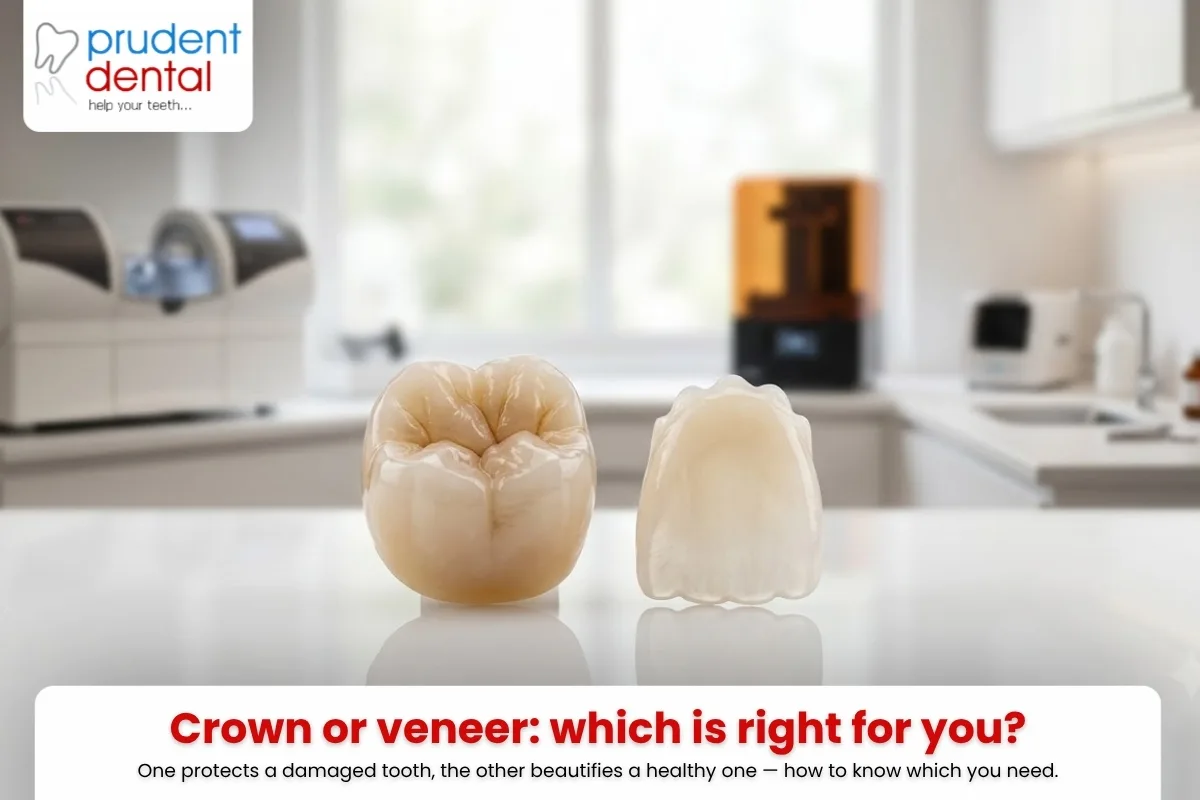
- A crown covers the whole tooth to protect and rebuild it; a veneer covers only the front surface to improve appearance.
- Damaged, heavily filled or root-treated teeth usually need a crown. Healthy teeth with a cosmetic issue often suit a veneer.
- A crown involves removing more tooth structure than a veneer, so the more conservative option is preferred when it will do the job.
- It is not really a matter of taste, the condition of the tooth and your goal decide which is appropriate.
Crowns and veneers are often mentioned in the same breath, and both can transform how a tooth looks, so it is easy to assume they are two versions of the same thing. They are not. One is mainly about protecting a tooth, the other mainly about appearance, and choosing well depends on understanding which problem you are actually solving. Here is the difference, in plain terms.
The core difference: how much they cover
Picture a tooth. A crown is a cap that fits over the whole thing, covering every side and the biting surface. Because it encases the tooth, it does two jobs at once: it restores the shape and it holds a weakened tooth together. A veneer is a thin shell bonded only to the front-facing surface, rather like a new facing on a cabinet door. It changes what you see, but it does not wrap around or reinforce the tooth.
That single distinction, whole-tooth coverage versus front-surface only, explains almost everything else about when each is used, how much tooth has to be prepared, and which situations suit which.
When a crown is the answer
A crown is primarily a restorative tool. It is the right choice when a tooth is structurally compromised and needs protecting, not just prettifying. Typical reasons include a tooth that is badly broken or cracked, one weakened by a very large filling, or a tooth that has had a root canal and become brittle. In each case the tooth needs something to hold it together and take the force of biting, and only full coverage does that.
A crown also improves appearance, so it can address colour and shape at the same time as strength. But its defining purpose is protection. Choosing a veneer for a tooth that really needs a crown risks the underlying tooth continuing to break.
When a veneer is the answer
A veneer is primarily a cosmetic tool for teeth that are fundamentally healthy. It shines on front teeth with issues that are about looks rather than strength: stubborn discolouration that whitening cannot shift, small chips, minor gaps, or a tooth that is a slightly awkward shape. Because it only covers the front and removes very little tooth, it is the more conservative option, which is a genuine advantage when it is appropriate.
What a veneer does not do is add meaningful strength. On a heavily damaged or root-treated tooth it is the wrong tool, not because it would look bad, but because the tooth underneath still needs protecting. If you are weighing cosmetic options for front teeth more broadly, our guide comparing veneers, bonding and whitening is a useful companion read.
Crown vs veneer at a glance
| Factor | Crown | Veneer |
|---|---|---|
| Coverage | The entire tooth, like a cap | The front surface only |
| Main purpose | Protect and rebuild a weak or damaged tooth | Improve the look of a healthy tooth |
| Tooth removed | More, all around the tooth | Less, a thin layer from the front |
| Best for | Broken, heavily filled or root-treated teeth | Discolouration, small chips, minor gaps, shape |
| Adds strength? | Yes, reinforces the whole tooth | No, mainly cosmetic |
How the decision is actually made
In practice you rarely have a free choice between the two, because the tooth points to the answer. The dentist looks at how much healthy tooth remains, whether it needs protecting, how much force it takes when you bite, and what you want to change about it. A sound front tooth you simply dislike the look of may be perfect for a veneer. A back tooth, or a front tooth that is cracked or root-treated, usually calls for a crown.
Because both involve permanently removing some tooth, the guiding principle is to choose the most conservative option that will genuinely do the job, and to be clear about whether the aim is strength, looks, or both. A good consultation should explain which is recommended and why the other was ruled out.
If you are considering either, the sensible first step is an examination so the advice is based on your actual tooth rather than a general rule. You can book a consultation and have the options explained on your own smile.
Sources & further reading
Indian Dental Association · American Dental Association (MouthHealthy)
Crown or veneer: your questions answered
Crown or veneer for your smile? Ask a cosmetic dentist. Call +91 70287 22200.
Call +91 70287 22200 · Open 7 days, 9 AM–9 PM (5 PM Sun)