Key takeaways
- E-max usually gives the most lifelike result on front teeth thanks to enamel-like translucency.
- Zirconia is the strongest of the three and the safest bet for molars, heavy bites and grinding.
- PFM is a proven, economical option, but a grey metal line can appear at the gum if it recedes.
- E-max and modern zirconia usually allow more conservative tooth preparation than PFM.
- No material suits every tooth: position, bite and gum health decide the right choice, not fashion.
Ask three dentists which crown material is best and you may get three answers, because zirconia, PFM (porcelain fused to metal) and E-max each earn their place on different teeth. In short: E-max usually gives the most lifelike result on front teeth, zirconia offers the greatest strength for molars and heavy bites, and PFM remains a proven, economical workhorse whose main drawback is a possible grey line at the gum over time. None of the three is best for every mouth. This guide compares them honestly, the way we explain them chairside at Prudent Dental Clinic in Viman Nagar, Pune.
The three families in plain terms
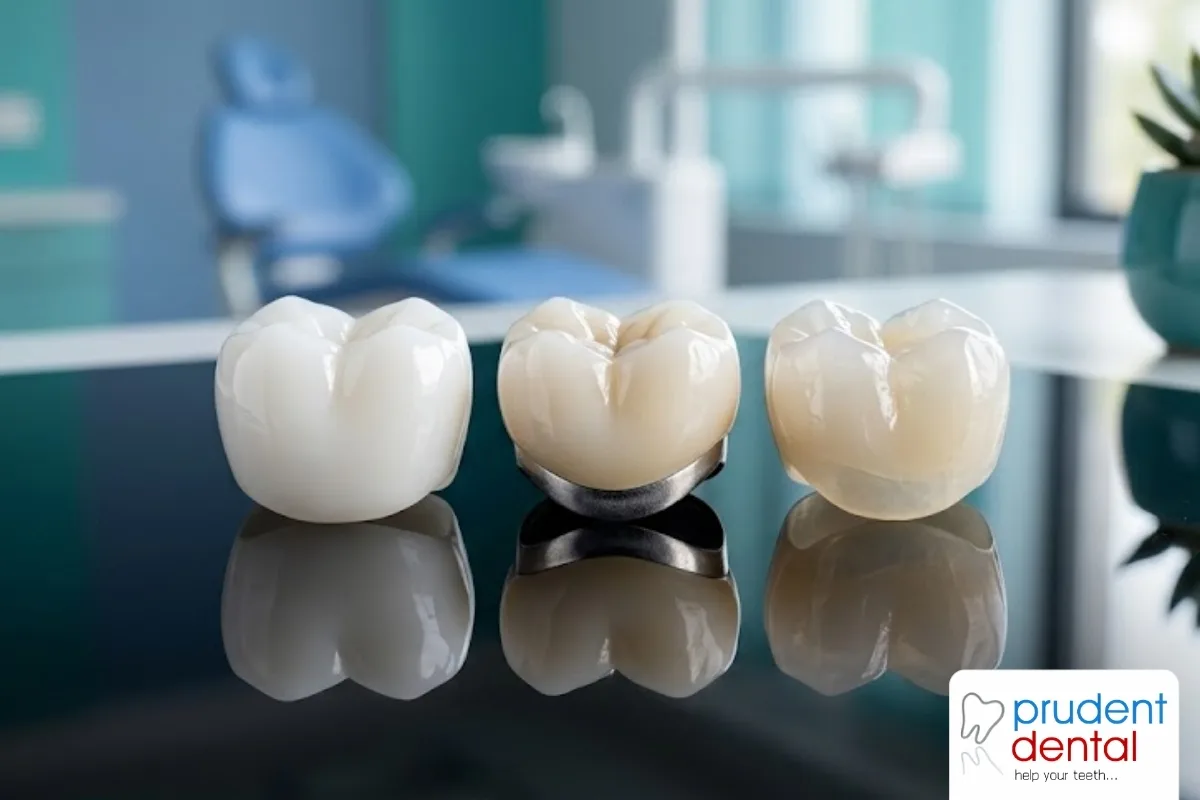
PFM stands for porcelain fused to metal: a thin metal shell is made to fit the prepared tooth, then porcelain is layered over it in tooth shades. It is the oldest of the three and has decades of clinical history behind it. E-max is a well-known brand of lithium disilicate, a glass ceramic pressed or milled as a single block and prized for the way it lets light pass through, much as natural enamel does. Zirconia is an extremely hard, metal-free ceramic that can be milled at full thickness, called monolithic, or veneered with porcelain for extra character.
Aesthetics: which looks most natural
For sheer realism at the front of the mouth, E-max is hard to beat. Lithium disilicate transmits and scatters light in a way that closely mimics enamel, so a well-made E-max crown on a front tooth can be genuinely difficult to spot, even for a dentist. It also takes surface staining and glazing beautifully, which lets the technician copy the small colour variations of your neighbouring teeth rather than producing a flat, uniform white.
Zirconia has closed the gap considerably. Early zirconia was strong but chalky and opaque; modern multilayered, high-translucency zirconia looks far more natural and suits most smiles well. PFM can still look very good in skilled hands, but the metal core blocks light from within, so the crown often appears slightly denser or more opaque than the tooth beside it, particularly in bright light or photographs. On a molar this rarely matters; on a front tooth it can.
The gum line over time
The gum line is where PFM shows its age. If the gum recedes even slightly, whether through ageing, gum inflammation or vigorous brushing, the metal edge of the crown can become visible as a grey or dark line at the margin. It is harmless, but on a front tooth it is often what prompts patients to ask for a replacement. Zirconia and E-max are ceramic throughout, so the margin stays tooth-coloured even if the gum position changes over the years.
Whatever material you choose, healthy gums protect the result. A margin that stays clean and snug resists decay and recession alike, and gum health is one of the biggest factors in how long dental crowns last. Brushing twice a day, cleaning between the teeth and keeping up regular professional cleans do more for a crown's appearance at the gum line than the choice of material does.
Strength and tooth preparation
Zirconia is the strongest dental ceramic in routine use. It shrugs off heavy bite forces, which makes it the default recommendation for molars, for patients who clench or grind, and for bridges that must carry load across a gap. Because it is strong even in thin sections, the dentist can often trim less of the natural tooth than a PFM would need. Monolithic zirconia has no separate porcelain layer, so there is nothing on the surface to chip; it simply needs careful polishing so it stays kind to the opposing teeth.
E-max is strong for a glass ceramic and, importantly, it is bonded adhesively to the tooth rather than simply cemented. That bond lets crown and tooth work as one unit and allows a conservative preparation, which is why E-max also underpins veneers and partial crowns. PFM sits at the other end: the technician needs room for a metal core plus porcelain on top, so tooth reduction is usually the greatest of the three, and the porcelain layer can chip away from the metal after years of chewing.
Front teeth, back teeth: where each shines
As a rule of thumb, front teeth favour E-max or high-translucency zirconia, molars favour monolithic zirconia or PFM, and premolars sit comfortably in the middle. For bridges, zirconia and PFM handle longer spans, while E-max is generally reserved for short bridges at the front of the mouth. Our crowns and bridges work uses all three families, matched to the tooth rather than to fashion. The table below sums up how they compare on the points patients ask about most.
| What matters | Zirconia | PFM | E-max |
|---|---|---|---|
| Natural translucency | Good, very good in newer types | Fair, the metal core dulls it | Excellent, closest to enamel |
| Strength under heavy bites | Excellent | Very good | Good, prefers lighter loads |
| Gum-line appearance over years | Stays tooth-coloured | Grey line possible if gums recede | Stays tooth-coloured |
| Tooth preparation needed | Often conservative | Usually the most | Conservative, bonded to the tooth |
| Chipping risk | Low when monolithic | Porcelain layer can chip | Low for single crowns |
| Where it shines | Molars, heavy bites, bridges | Back teeth, longer bridges | Front teeth, premolars, veneers |
How we choose, and what it costs
At Prudent Dental Clinic in Viman Nagar, Dr. Puja Bansal (BDS), who brings 27 years of experience to every case, examines the tooth, the bite, the gum health and how much of the tooth shows when you speak and smile before recommending a material. Where a root canal is involved, consultant endodontist Dr. Mrunal Godse assesses the tooth first, because a crown is only ever as sound as the foundation beneath it.
On cost, the honest answer is that the three families sit at different points, and the final figure depends on more than the material: the laboratory and technician behind the crown, whether the tooth first needs a root canal or a post and core, the number of units in a bridge, and any warranty the lab provides. We explain what affects crown and bridge cost separately, and after an examination you receive a written, itemised estimate before any work begins. Call +91 70287 22200 to book; the clinic is open seven days a week.
Zirconia vs PFM vs E-max crowns FAQs
Sources & further reading: American Dental Association (MouthHealthy); NIDCR, US National Institute of Dental & Craniofacial Research; NHS, Dental Health; Indian Dental Association.
Questions about your own teeth? Call +91 70287 22200.
Call +91 70287 22200 · Open 7 days, 9 AM–9 PM (5 PM Sun)