

Key takeaways
- Dental implants can last many years, often decades, with healthy gums and good daily hygiene. No dentist can honestly promise a fixed lifespan.
- The titanium post in the jaw usually outlasts the crown fixed on top, which may need renewing sooner.
- Gum disease around the implant, smoking, uncontrolled diabetes and heavy grinding are the main things that shorten an implant's life.
- Regular professional check-ups matter as much as the implant itself, because early gum inflammation is easy to reverse when caught in time.
An implant is a real investment in your mouth, so it is fair to ask how long it will actually serve you. The honest answer is qualitative, not a guarantee: with the right care, implants can last a very long time. Here is what shapes that lifespan, why the crown and the post age differently, and what quietly shortens the life of an implant.
How long do dental implants last?
There is no fixed lifespan, and no honest dentist will promise one. With healthy gums, careful daily cleaning and regular professional check-ups, a dental implant can last many years and often decades. Many patients keep theirs for the rest of their lives, though the crown on top may need renewing sooner than the post below.
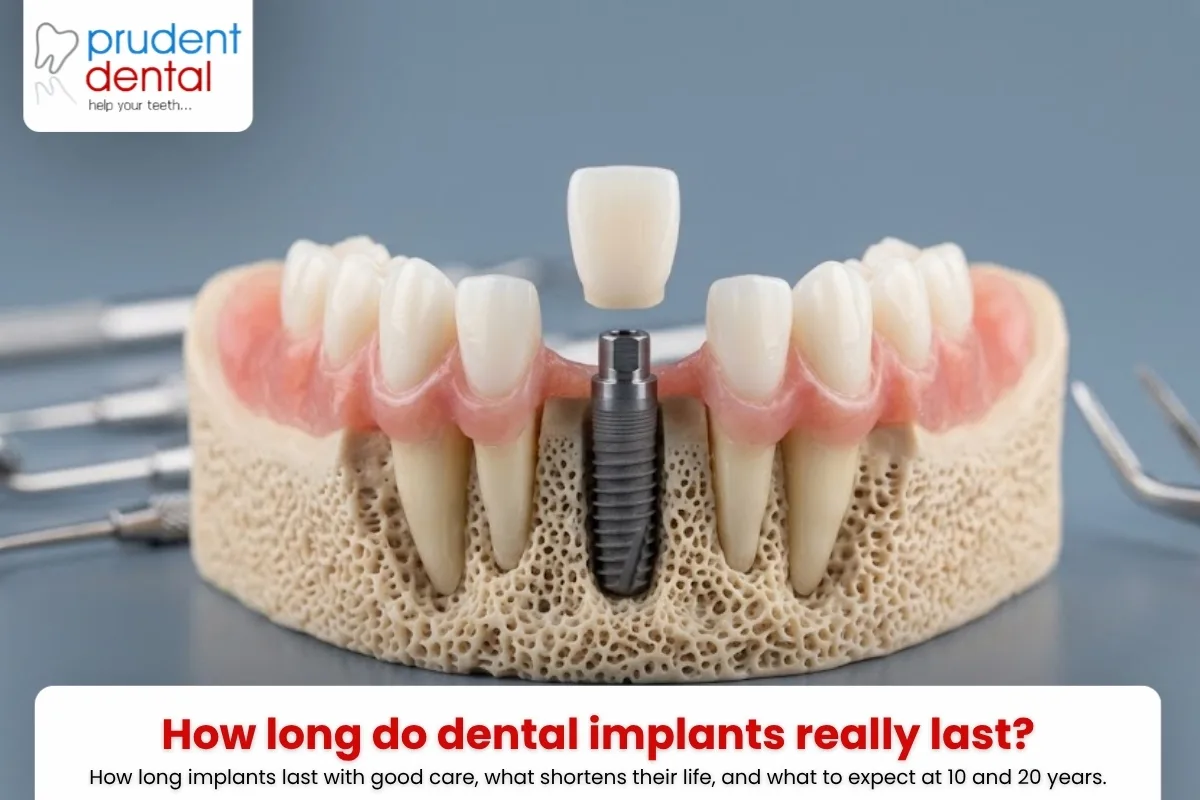
It helps to think of an implant as two parts with two different lifespans. The first is the implant post, a small biocompatible screw, usually titanium, that the jaw bone grows around and holds firmly in place. Because it sits protected inside bone and cannot decay, this part is remarkably durable. The second part is everything you can see and use: the crown on top, and the small screw and connector that join it to the post.
What decides longevity is less the implant itself and more the living tissue around it. An implant cannot get a cavity, but the gum and bone supporting it can become inflamed if plaque is allowed to build up. So the real question is not "how long does the hardware last" but "how well is the mouth around it looked after" over the years.
Do implants last a lifetime?
For some patients they can, but a lifetime cannot be promised to anyone. The post fused into the jaw is the most durable part and frequently lasts for decades. The crown, screw and surrounding gum are the components most likely to need attention first, which is normal and usually straightforward to address.
Comparing the two parts side by side makes the difference clear, and explains why a well-cared-for implant can keep serving you long after its first crown has been refreshed.
| The implant post | The crown on top | |
|---|---|---|
| Where it sits | Inside the jaw bone, protected | Above the gum, exposed to the mouth |
| Everyday stress | Held steady by surrounding bone | Takes direct chewing and biting wear |
| Can it decay? | No; titanium does not decay | No, but it can chip, stain or loosen over time |
| Typical longevity | Often lasts many years, frequently decades | May need renewing sooner than the post |
| If it needs work | Rarely replaced when gums stay healthy | Usually simpler to refresh than the post |
So when someone says an implant "lasts a lifetime," they usually mean the post. Expecting the visible crown to occasionally need renewing over a long life is realistic, not a sign of failure. Keeping your routine dental examinations lets your dentist spot a worn crown or an early gum problem before it turns into anything bigger.
What makes an implant fail early?
Early problems almost always trace back to the tissue around the implant rather than the implant itself. Gum infection (peri-implantitis), smoking, poorly controlled diabetes, heavy night-time grinding and skipped maintenance visits are the usual culprits. Reassuringly, most of these are within your control once you know them.
Peri-implantitis is the most common reason implants are lost. It is inflammation of the gum and bone around the implant, driven by plaque, and in its early stage it often causes little pain, which is exactly why regular reviews matter. Smoking slows healing and is consistently linked with poorer implant outcomes, while uncontrolled diabetes impairs the same healing an implant depends on. Heavy grinding can overload an implant over time, though a simple night guard usually manages this well.
The practical takeaway is that you protect an implant much as you protect a natural tooth. Brush twice daily, clean between the teeth as your dentist shows you, and do not skip your check-ups. If you would like to understand the risk factors in more depth, our guide to what causes dental implant failure goes further into each one and how to avoid it.
Personal circumstances always matter here, which is why a lifespan cannot be quoted from a web page. At Prudent Dental Clinic in Viman Nagar, Pune, implant care is led by Dr. Puja Bansal (BDS), an implantologist with 27 years of experience (Maharashtra State Dental Council registration A8860). If you already have an implant, or are weighing one up, a review can set out a realistic maintenance plan for your mouth. You are welcome to book a consultation; the clinic is open seven days a week, 9 AM to 9 PM (5 PM on Sundays).
Replacing many teeth, or hoping for teeth in one visit? See our 2026 guides to full mouth implants and same-day dental implants.
Sources & further reading
World Health Organization, Oral Health · NHS, Dental Health
Dental implant lifespan questions, answered
Want your implant to last? Talk to Dr. Bansal. Call +91 70287 22200.
Call +91 70287 22200 · Open 7 days, 9 AM–9 PM (5 PM Sun)