

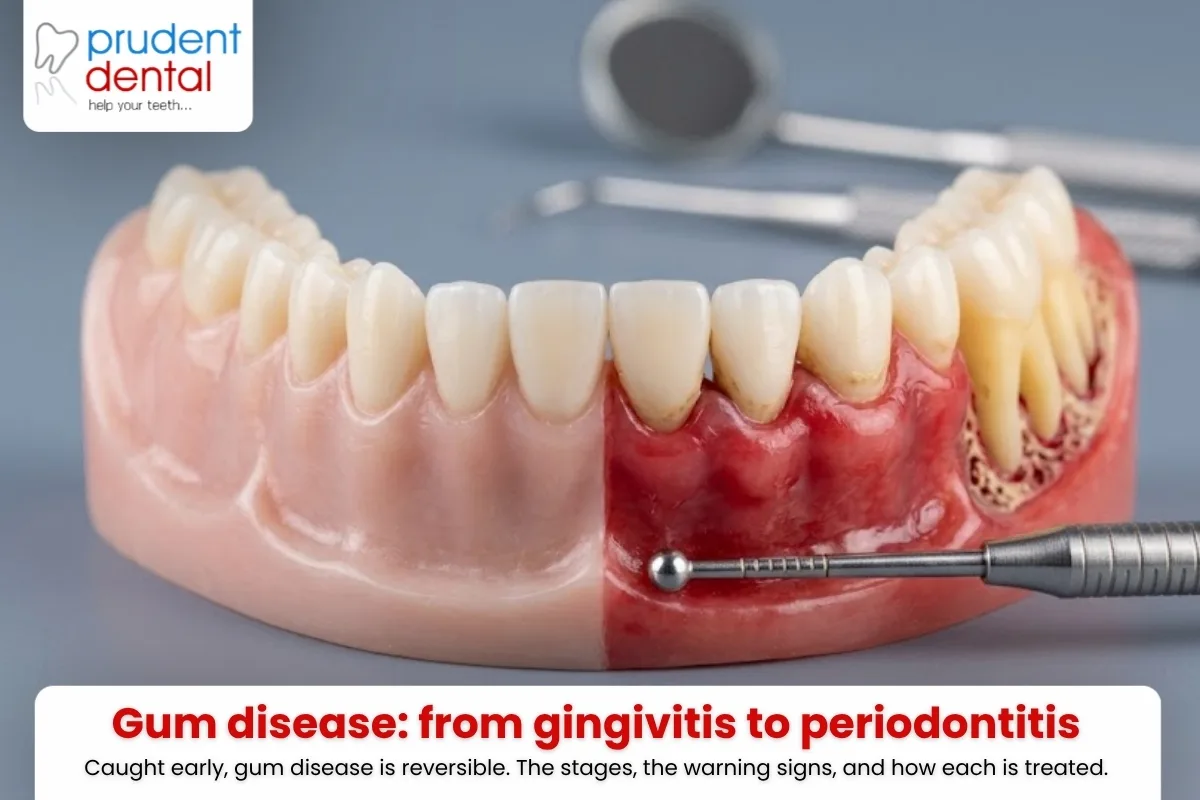
Key takeaways
- Gum disease has two stages: gingivitis (early, gum inflammation) and periodontitis (advanced, with bone loss).
- Gingivitis is fully reversible. Periodontitis is not, because lost bone does not grow back, but it can be stopped from worsening.
- Bleeding gums are the earliest warning sign and the best moment to act.
- It is largely preventable: daily cleaning plus regular professional scaling keeps the gums healthy.
Gum disease is one of the most common conditions dentists treat, and one of the most quietly damaging, because it is usually painless until it is advanced. It is also, in its early stage, completely reversible. Understanding how it progresses, from mild gingivitis to serious periodontitis, is the key to catching it while it can still be fully undone. This guide explains the stages, the warning signs, and how each is treated.
What causes gum disease?
It starts with plaque, the soft film of bacteria that forms on the teeth every day. When plaque is not removed, it hardens into tartar along the gumline, and the bacteria irritate the gums. Your body responds with inflammation, and that inflammation, sustained over time, is what damages the gums and eventually the bone. Smoking, poorly controlled diabetes, certain medicines and hormonal changes all raise the risk by affecting how the gums respond.
Stage 1: Gingivitis (the reversible stage)
Gingivitis is inflammation of the gums only. The gums become red, a little puffy, and bleed easily when you brush or floss. Importantly, the bone and the deeper support around the teeth are not yet affected. This is the stage everyone wants to catch, because it heals completely: once the plaque and tartar driving it are professionally removed and good daily cleaning keeps them away, the gums return to full health with no lasting damage.
The single most useful thing to know is that bleeding gums are not normaland are the earliest sign. If your gums bleed when you brush, that is gingivitis asking to be dealt with. We cover this in detail in why do my gums bleed when I brush.
Stage 2: Periodontitis (the damaging stage)
If gingivitis is left untreated, it can advance to periodontitis. Here the infection spreads below the gumline, and the body's prolonged inflammatory response begins to break down the bone and ligament that anchor the teeth. Small pockets form between the gum and tooth where bacteria thrive out of reach, the gums may recede, and over time teeth can loosen, drift, or eventually be lost.
The difference that matters is that periodontitis causes permanent damage: lost bone does not grow back. It cannot be reversed. What it can be is stopped. With treatment, the disease is halted and the remaining support is protected, which is why early action makes such a difference to how many teeth you keep.
How gum disease is treated
- Early disease: a professional scaling and polishing to remove plaque and tartar, plus coaching on daily cleaning. For gingivitis, this often resolves it completely.
- Established disease: deeper cleaning below the gumline (root planing), sometimes across several visits and occasionally with local anaesthetic for comfort.
- Maintenance: more frequent cleanings to keep pockets under control, because periodontitis is managed for life rather than cured.
- Risk factors: stopping smoking and controlling diabetes are a genuine part of treatment, not an afterthought.
Why it is worth taking seriously
Beyond the mouth, gum disease is linked to general health, including heart disease and blood-sugar control, which is another reason not to let it drift. The reassuring part is that it is largely preventable and, caught early, entirely reversible. Regular check-ups catch it long before you would notice a problem yourself.
At Prudent Dental Clinic in Viman Nagar, Pune, we check your gums at every visit and treat gum disease at whatever stage we find it, honestly and without alarm. The clinic is open seven days a week from 9 AM to 9 PM (5 PM on Sundays), and you can book a check-up online or call. If your gums bleed or feel tender, that is the moment to come in.
Sources & further reading
Indian Dental Association · World Health Organization, Oral Health · NHS, Dental Health
Gum disease FAQs
Bleeding or tender gums? Catch it early. Call +91 70287 22200 to book a check-up.
Call +91 70287 22200 · Open 7 days, 9 AM–9 PM (5 PM Sun)