

Key takeaways
- Clear aligners can match braces for mild to moderate crowding and spacing; complex tooth movements are generally still more predictable with fixed braces.
- Aligners only work while worn. Most systems assume roughly 20–22 hours a day, so results depend heavily on your discipline.
- Braces are fixed and need no willpower, but they are visible, restrict some foods and take more effort to clean around.
- The right choice comes from an orthodontic assessment of your teeth and bite, not from marketing.
Few dental decisions attract more marketing than teeth straightening. Aligner brands, often marketed as invisible or transparent braces, promise discreet convenience; traditional braces carry decades of history. Both can work well. Both can also disappoint when matched to the wrong mouth. At Prudent Dental Clinic in Viman Nagar, Pune, this is one of the most common questions patients bring to an orthodontic consultation, and the honest answer is rarely as simple as an advertisement suggests.
Are clear aligners as good as braces?
For mild to moderate problems (light crowding, small gaps, or minor relapse after earlier treatment) clear aligners can produce results comparable to braces in experienced hands. For complex movements, such as rotating rounded teeth, closing large extraction gaps or correcting significant bite issues, fixed braces generally remain the more predictable tool.
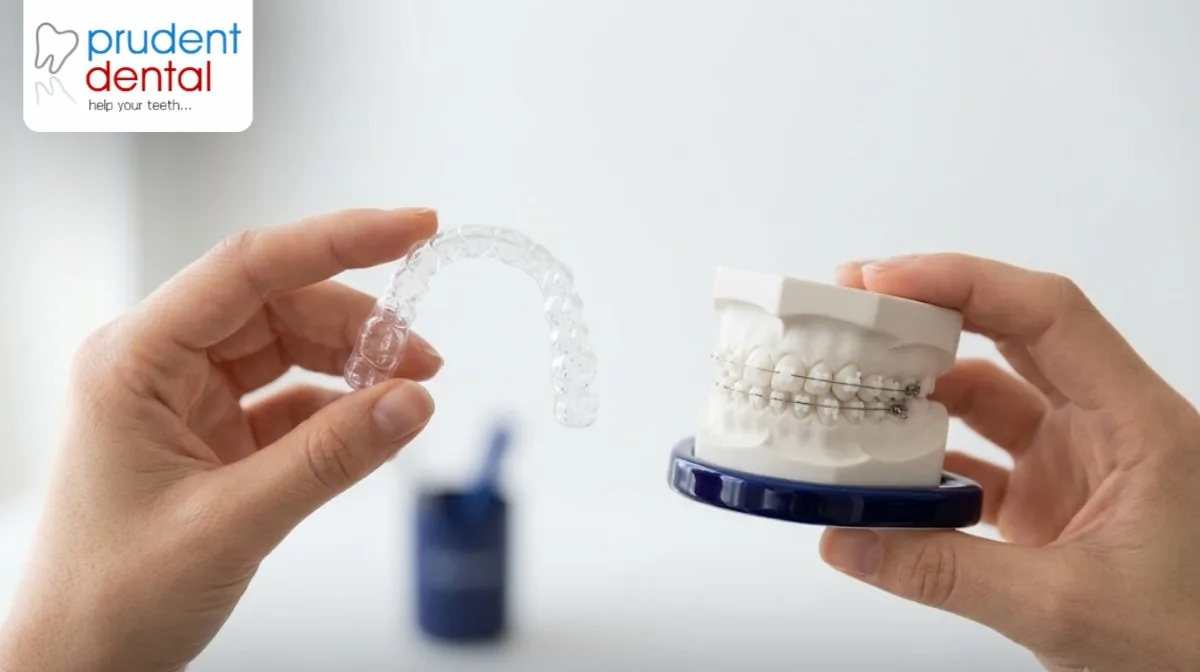
The difference comes down to how each appliance moves teeth. Braces are brackets bonded to the teeth and connected by a wire, which gives the clinician continuous, three-dimensional control. That includes the ability to move roots through bone, not just tip crowns. Aligners are a sequence of removable plastic trays, each nudging the teeth a small step further along a digitally planned path, often helped by small tooth-coloured attachments bonded to certain teeth.
Aligners are strong at tipping teeth into alignment and closing modest spaces. They have less grip when a tooth needs to be rotated a long way, moved vertically, or shifted bodily through bone. So case selection matters far more than the brand on the box, and so does the judgement of the clinician planning your treatment.
Which is faster, braces or aligners?
Neither is automatically faster. Treatment time depends far more on how far your teeth need to move than on which appliance you choose. Simple aligner cases can finish sooner than average, complex corrections take longer either way, and every hour an aligner spends out of your mouth quietly stretches the timeline.
Braces have one structural advantage here. They are fixed, so they work around the clock without any input from you. Aligners only move teeth while they are being worn. A tray left in its case during a long lunch, a wedding season or a stretch of travel does nothing, and teeth that drift off the planned path may need extra 'refinement' trays, adding weeks or months. When aligner companies advertise short treatment times, they are usually describing the mildest cases, not a faster technology.
How do braces and aligners compare day to day?
Day to day, the two feel very different. Braces are fixed and visible, and some foods are off the menu, but they demand no willpower and work around the clock. Aligners are discreet and removable, so you eat freely and clean normally, but they only work while they are actually on your teeth.
| Factor | Fixed braces | Clear aligners |
|---|---|---|
| Case complexity | Handles simple to complex movements, including significant bite correction | Best suited to mild–moderate crowding and spacing; complex cases need careful selection |
| Discipline needed | None. Fixed in place, working continuously | High. Roughly 20–22 hours of wear every day, sustained for months |
| Aesthetics | Visible; ceramic brackets are less noticeable than metal | Close to invisible at conversational distance |
| Hygiene | Harder. Cleaning around brackets and wires takes real effort | Easier. Trays come out, so you brush and floss as normal |
| Food freedom | Hard, sticky and chewy foods are off the menu | No restrictions, since trays are removed for every meal |
| Breakages & mishaps | Brackets can debond and wires can poke, needing a repair visit | Trays can be lost or cracked, needing a replacement |
Hygiene deserves special mention. Plaque that lingers around brackets can leave permanent white marks on enamel, so braces demand meticulous brushing and interdental cleaning. Aligners make cleaning easier, but they bring their own trap. Sipping tea, coffee or anything sugary with trays in bathes the teeth in it. Trays come out for everything except plain water.
Are aligners worth the extra cost?
Aligners are usually the more expensive option, and whether the premium is worth it is personal. If discreet treatment and food freedom matter to you and your case suits aligners, many people feel it is. If your case is complex, or 22-hour daily wear sounds unrealistic, braces may serve you better.
The higher price largely reflects digital planning and the laboratory work behind a long series of custom trays. There is no meaningful fixed price for either option. The honest number depends on your teeth, so treat any quote given before an examination with caution. It is also worth budgeting for what comes after. Both routes end with retainers, and both may need mid-course corrections.
One caution applies whichever way you lean. Orthodontic treatment moves teeth through living bone and can affect gums and roots, so it should be planned from a proper examination and monitored by a qualified dentist or orthodontist throughout. It should not be managed remotely from impressions posted in a box.
How should you decide between braces and aligners?
The right appliance depends on your bite, the movements your teeth need, your budget and how disciplined you can realistically be. An examination, usually with X-rays and photographs, is the only reliable way to know which options genuinely suit your case, and which would be a compromise.
While you wait for that assessment, try a self-test: be honest about your habits. If you know you would forget trays at restaurants or leave them out during long workdays, a fixed appliance protects you from yourself. If your priority is appearing brace-free at work and your crowding is mild, aligners deserve a serious look. Either way, start with a thorough dental examination so that gum disease or untreated decay is dealt with before any tooth movement begins. Moving teeth in an unhealthy mouth is never a good idea.
If you are weighing the two options, you can book an orthodontic assessment and have the comparison made on your own teeth rather than in the abstract. A good consultation should tell you which option is possible and, just as important, which is predictable for your case. It is entirely reasonable to ask why.
Sources & further reading
Indian Dental Association · American Dental Association (MouthHealthy)
Braces or aligners? Your questions answered
Not sure which is right for your smile? Book an orthodontic assessment. Call +91 70287 22200.
Call +91 70287 22200 · Open 7 days, 9 AM–9 PM (5 PM Sun)